
Early Tooth Loss
A primary molar lost to decay or injury well before its natural shedding time may leave space vulnerable to drifting.

Port Dover Family Dentistry
Space maintainers in Port Dover may help preserve room for permanent teeth after a baby tooth is lost too early, based on a child’s growth and bite.
Let’s get you smiling
Tell us how we can help. Our team will follow up to confirm a time.
Space maintainers in Port Dover
Primary teeth naturally guide permanent teeth and help preserve the length of the dental arch. When a baby tooth is lost much earlier than expected, nearby teeth may drift into the open space and make eruption more difficult.
A space maintainer is a small fixed or removable appliance designed to hold selected teeth in position. It is not needed after every early tooth loss, so the decision is based on the missing tooth, your child’s bite, age, eruption pattern and ability to care for the appliance.

Assessment comes first
Space maintenance is individualized. The dentist considers which tooth was lost, how long ago it was lost, available space and the development of the permanent successor before recommending an appliance.
Planning for eruption
A primary molar lost to decay or injury well before its natural shedding time may leave space vulnerable to drifting.
X-rays may help show the position and stage of the permanent tooth expected to replace the missing baby tooth.
Crowding, spacing, eruption sequence and the relationship between the arches influence whether maintenance is useful.
Oral hygiene, cooperation, medical needs and the ability to attend follow-up visits are part of safe appliance planning.
From assessment to follow-up
The dentist examines your child’s bite and eruption pattern and may use X-rays or measurements to understand the developing permanent teeth.
If appropriate, a fixed or removable design is selected for the location and clinical need. We explain placement, cleaning and what your child should avoid.
Regular reviews check the appliance, supporting teeth, hygiene and eruption. The maintainer is removed or adjusted when it has completed its purpose.
Timing matters
The developing permanent tooth and the amount of bone above it help determine whether space maintenance is useful and how long an appliance may be needed. X-rays are recommended only when they can add information that is not available from the clinical examination alone.
Follow-up is part of treatment. The appliance, cement, supporting teeth, gum tissue and eruption path need regular review so the maintainer can be repaired, adjusted or removed at the right time.
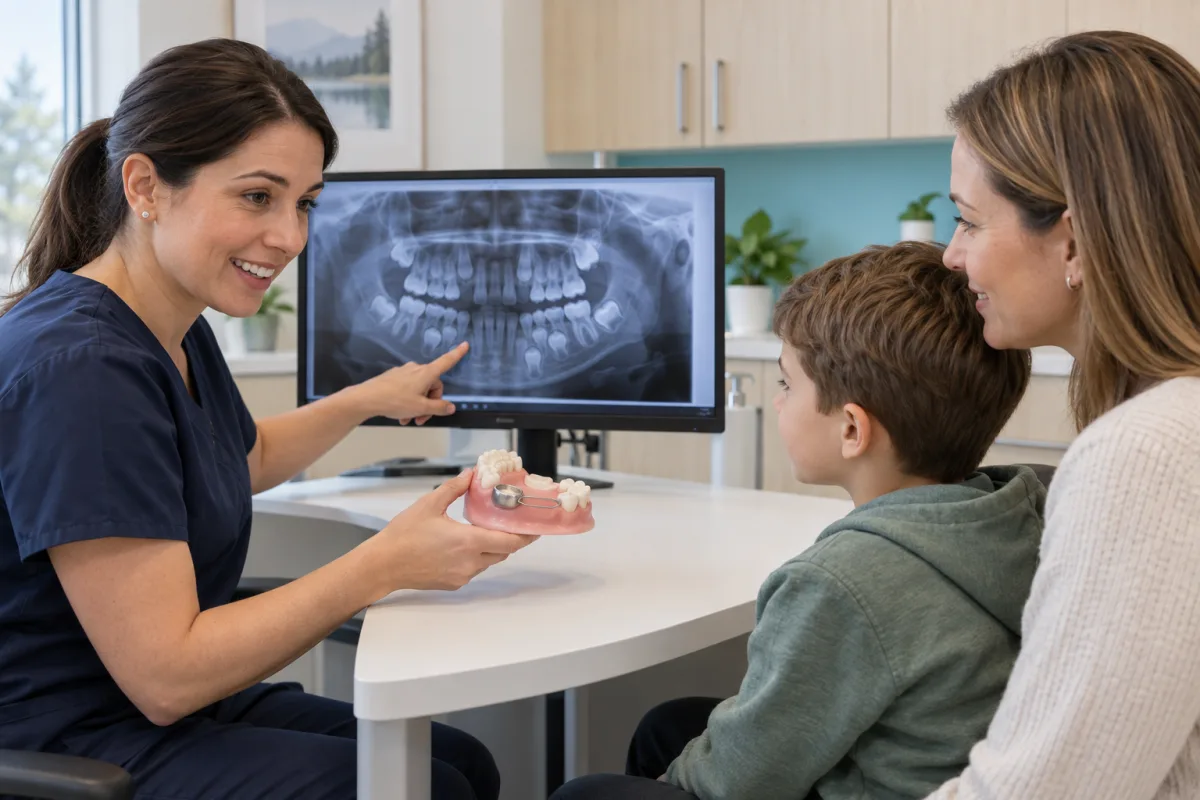
The position and root development of the permanent successor help guide timing.
Measurements and the existing bite show whether nearby teeth are likely to drift into the opening.
Monitoring helps prevent an appliance from becoming loose, trapping plaque or interfering with eruption.
Fixed and removable designs
There is no universal space maintainer. The location and number of missing teeth, the child’s development and their ability to care for an appliance shape the design.
A small fixed appliance may use a band on one tooth and a loop that spans a single nearby space.
Different arches or patterns of tooth loss may require a passive lingual, palatal or other custom fixed appliance.
A removable design may suit selected children who can wear, store and clean it consistently.
When timing, spacing and permanent-tooth development are favourable, monitoring without an appliance may be appropriate.
Potential problems include breakage, plaque accumulation, cavities, gum irritation and interference with eruption, which is why cleaning and scheduled follow-up are essential.
Looking after the appliance
Brush carefully around bands and wires and clean between teeth as instructed. Sticky or very hard foods can loosen or bend some appliances, so follow the eating guidance provided for your child’s design.
Call if the appliance becomes loose, breaks, rubs the gums or interferes with eating. Do not bend or remove a fixed appliance at home. Keep scheduled reviews so it does not remain longer than needed.
Developing smiles
We can assess the available space and developing permanent teeth, then explain whether observation or a space maintainer is appropriate.
Space maintainer questions
No. The decision depends on the tooth, timing, existing bite, amount of space and development of the permanent replacement. Some spaces can be monitored without an appliance.
Some are fixed to nearby teeth and others are removable. The recommended design depends on the location, number of missing teeth, your child’s age and ability to use and clean it reliably.
Timing varies. The appliance is reviewed as the mouth grows and is generally removed when the permanent tooth is ready to erupt or when it is no longer needed.
Plaque can collect around an appliance if cleaning is difficult. Careful brushing, cleaning between teeth, fluoride toothpaste and regular reviews help protect the supporting teeth.
Call the dental office and avoid hard or sticky foods. Do not try to bend, glue or reposition a fixed appliance yourself because it may damage the teeth or gums.
Recognized year after year
Best Dentists in Norfolk
Proudly recognized among Norfolk’s top-rated dental practices for six consecutive years.

2021 Winner

2022 Winner

2023 Winner

2024 Winner

2025 Winner

2026 Winner
Stories from our patients
Watch a patient’s experience and browse more five-star reviews from people who have visited our Port Dover dental clinic.
Patient video
A patient shares the welcoming atmosphere and positive experience they found at our Port Dover office.
Google reviews
Swipe or use the arrows
Read all reviewsOur community
Your next visit can start today
New patients and CDCP patients are welcome. Tell us how we can help and our Port Dover dental team will follow up with you.
Evening appointments Monday and Tuesday