
Patient video
Welcoming and Wonderful Practice
A patient shares the welcoming atmosphere and positive experience they found at our Port Dover office.
★★★★★

Port Dover Family Dentistry
X-rays show decay between teeth, bone levels and roots that an exam cannot see. Glen Meyer patients learn why images are taken, how often and what they show.
Let’s get you smiling
Tell us how we can help. Our team will follow up to confirm a time.
Seeing patients from Glen Meyer and the surrounding countryside at our Port Dover office
Browse all dental services for Glen MeyerSeeing below the surface
Many dental problems start in places the eye cannot reach: between teeth, under old fillings, at the tips of roots or in the bone supporting the teeth. Digital X-rays capture images of these areas so the dentist can detect decay, infection, bone loss and other changes earlier than a visual exam alone would allow.
Glen Meyer patients visiting our Port Dover office may be recommended X-rays as part of an exam or when a specific problem needs investigating. The team can explain what type of image is suggested, why it is needed and how the findings will guide your care.
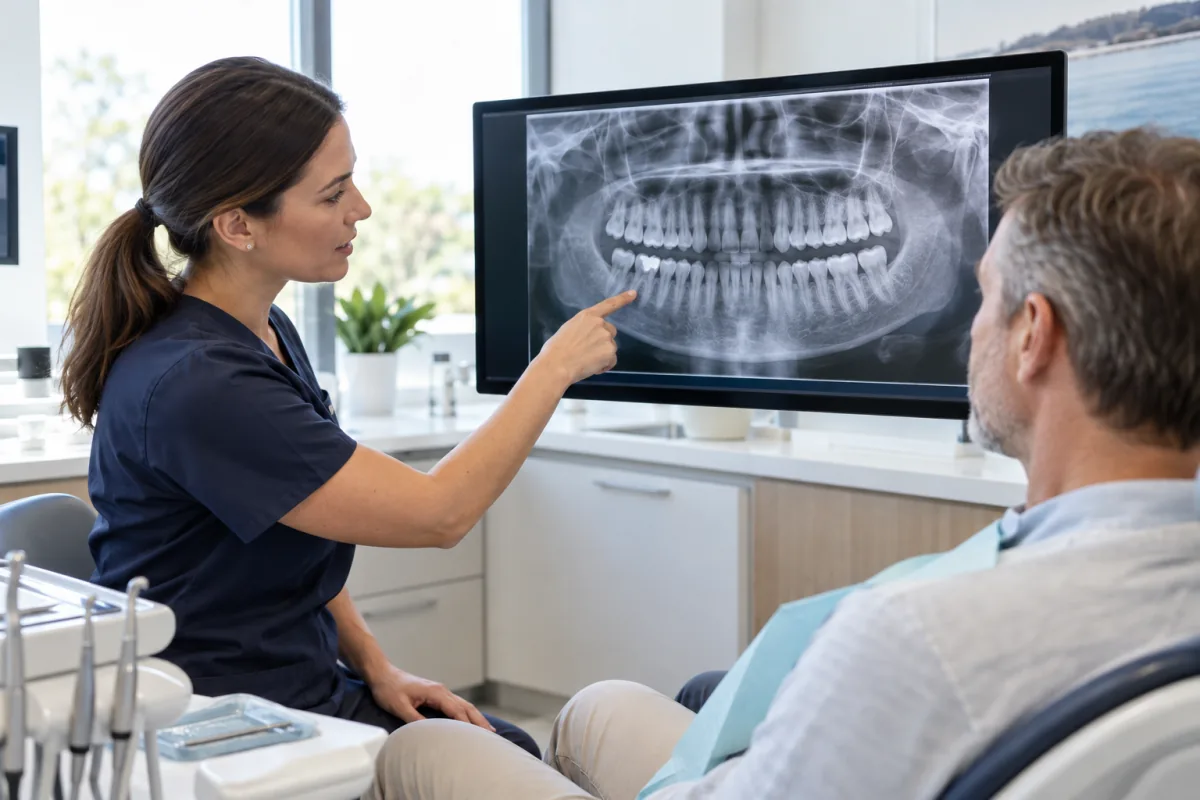
Why X-rays help
X-rays can show cavities between teeth and under existing fillings, bone loss from gum disease, abscesses at the root tips, impacted or developing teeth, and certain cysts or growths. For children, they help track how adult teeth are forming. Finding problems early often allows for simpler, more conservative treatment and can prevent pain from developing later.
Before procedures such as root canal treatment, extractions or implants, X-rays help the dentist see root shape, nearby structures and bone levels. They also provide a baseline for comparison at future visits. Ask the dentist to show you your images and explain what they reveal, so you have a clearer picture of your oral health.
Types of images
Bitewing X-rays show the crowns of upper and lower back teeth together and are useful for spotting decay between teeth and checking bone levels. Periapical X-rays show an entire tooth, from crown to root tip, and are often used to investigate pain, infection or the result of a root canal. Each targets specific diagnostic needs.
A panoramic X-ray captures a broad view of the teeth, jaws and surrounding structures in a single image. It may be used to assess wisdom teeth, jaw joints or overall development. In some cases, more detailed three-dimensional imaging is recommended, often through referral. The dentist will explain why a particular image type is suggested for you.
Safety and frequency
Dental X-rays involve a low dose of radiation, and digital sensors generally require less exposure than older film methods. Protective measures may be used, and images are taken only when the expected benefit justifies them. Let the team know if you are pregnant or might be, so the dentist can decide whether to delay non-urgent images.
How often you need X-rays depends on your age, cavity risk, gum health and any symptoms. Someone with frequent cavities or gum disease may need images more often than someone with stable oral health. If you have recent X-rays from another dentist, ask whether they can be shared to avoid repeating images unnecessarily and reduce your overall exposure.
Understanding results
Digital images appear on screen almost immediately, which allows the dentist to review them with you during the appointment. Ask questions about anything that is pointed out, such as shadows that indicate decay or changes in bone levels. Understanding the findings can make treatment recommendations easier to follow and decide upon with confidence, rather than taking them on trust.
X-rays become part of your dental record and help the dentist compare changes over time. If you are seeing a specialist or moving to another practice, images can usually be shared with your consent. Keeping your history in one place helps avoid unnecessary repeat imaging and supports more informed decisions about your care over many years.
Planning your appointment
X-rays are usually taken during your appointment at our Port Dover office when the dentist recommends them. Let the team know about any recent images taken elsewhere before your visit.
Mention pregnancy, recent radiation treatments or concerns about imaging, so the dentist can discuss timing and any alternatives with you beforehand.
Before you book
Have a question about your situation? Our team can help you plan a visit.
Dental X-rays use a low dose of radiation, and digital systems typically reduce exposure further. Images are recommended only when the dentist believes the diagnostic benefit outweighs the small risk. Ask questions if you have concerns about safety or frequency.
Many problems, such as cavities between teeth or early bone loss, cause no symptoms at first. X-rays help detect them before they become painful or more difficult to treat. The dentist recommends images based on your risk and history.
Let the team know if you are pregnant or might be. Non-urgent X-rays may be postponed, while images needed for urgent problems can sometimes be taken with precautions. The dentist will discuss the options and what is appropriate in your situation.
Children’s X-rays depend on their age, cavity risk and development. Some need them more often to monitor decay or adult teeth coming in. The dentist will recommend images only when they are expected to provide useful information for your child’s care.
Often, yes, with your consent. Providing recent images can reduce the need for repeat X-rays and help the dentist compare changes. Contact your previous office or ask our team how to arrange a transfer before your appointment.
Routine exams catch decay, gum disease and wear before they hurt. Glen Meyer patients can see what a checkup covers and how often to book one in Port Dover.
Your first exam sets a baseline for future care. Glen Meyer patients new to our Port Dover office can see what to bring, what is checked and how plans form.
Recognized year after year
Best Dentists in Norfolk
Proudly recognized among Norfolk’s top-rated dental practices for six consecutive years.

2021 Winner

2022 Winner

2023 Winner

2024 Winner

2025 Winner

2026 Winner
Stories from our patients
Watch a patient’s experience and browse more five-star reviews from people who have visited our Port Dover dental clinic.
Patient video
A patient shares the welcoming atmosphere and positive experience they found at our Port Dover office.
Google reviews
Swipe or use the arrows
Read all reviewsYour next visit can start today
New patients and CDCP patients are welcome. Tell us how we can help and our Port Dover dental team will follow up with you.
Evening appointments Monday and Tuesday