
Patient video
Welcoming and Wonderful Practice
A patient shares the welcoming atmosphere and positive experience they found at our Port Dover office.
★★★★★
Port Dover Family Dentistry
A sharp twinge when biting or releasing can point to a crack. Long Point patients can have a cracked tooth examined and repairs explained in Port Dover.
Let’s get you smiling
Tell us how we can help. Our team will follow up to confirm a time.
Caring for Long Point residents, cottagers and visitors at our Port Dover office
Browse every dental service for Long PointWhen biting hurts
A cracked tooth often announces itself with a brief, sharp pain when chewing, especially when releasing a bite, or with sensitivity to cold that comes and goes. Cracks may begin as fine lines in enamel or extend deeper toward the root. Large fillings, grinding and biting hard foods can all make teeth more vulnerable, particularly molars and premolars.
If chewing has started to hurt on one side, Long Point patients can arrange an assessment at our Port Dover office to locate the crack and talk through how to protect the tooth before it worsens.
Symptoms
Note whether pain happens on biting, on release, with cold or sweet foods, or without any trigger at all. Try to identify which side and whether upper or lower. Cracks can be tricky to locate because discomfort sometimes seems to move. Writing down what you notice over a few days can make the exam more focused.
If a piece of tooth has broken away, you may feel a sharp edge or see a gap. Keep any fragment and avoid chewing on that side. Swelling, a pimple on the gum or constant throbbing may suggest the nerve or surrounding tissues are involved, and those signs deserve a prompt call.
Diagnosis
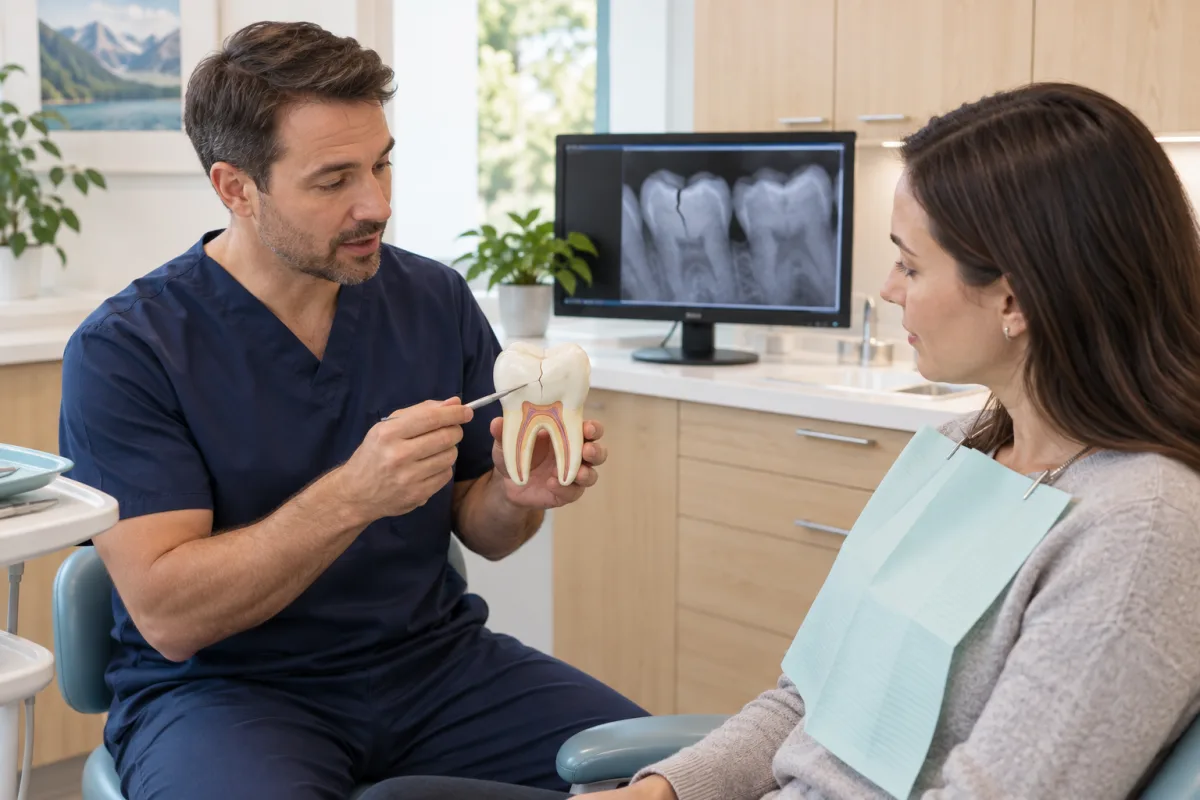
The dentist may ask you to bite on a special instrument tooth by tooth, test sensitivity to cold, use magnification or light, and take X-rays. Cracks do not always show on X-rays, so clinical tests matter. Existing fillings may be examined closely, since cracks often start along their edges.
The direction and depth of the crack determine what can be done. A crack limited to the crown may be protected with a restoration, while one extending below the gum or splitting the root may mean the tooth cannot be saved. The dentist will explain what was found and how confident the diagnosis is.
Treatment
Minor cracks may be bonded or smoothed. More often, an onlay or crown is recommended to cover the cusps and reduce flexing that spreads the crack. A temporary restoration may be placed first to see whether symptoms settle. The dentist will explain why a particular level of coverage is suggested.
If the crack has reached the nerve, root canal treatment may be needed before the tooth is crowned. When a crack splits the tooth or extends deep into the root, extraction may be the safer choice. Replacement options such as an implant, bridge or partial denture can then be discussed.
Prevention
Follow instructions about eating on a temporary restoration and keep follow-up visits. Mild sensitivity can occur after treatment and often settles. If pain on biting returns or worsens, or the gum near the tooth swells, let the office know, since cracks can sometimes progress despite treatment.
Avoid chewing ice, hard candy and unpopped popcorn kernels, and do not use teeth as tools. If you grind or clench, a night guard may reduce stress on teeth. Large old fillings may be monitored more closely, since they can leave walls of the tooth weaker and more prone to cracking.
Planning your appointment
Call our Port Dover office and describe when the tooth hurts and which side seems affected. The team can discuss urgency and arrange a focused assessment of the area.
Bring any broken piece, mention recent dental work on that side and note whether you grind your teeth at night.
Before you book
Have a question about your situation? Our team can help you plan a visit.
Pain on release is a classic sign of a cracked tooth, as the pieces flex apart and back. Mention this pattern to the dentist, as it helps guide the testing used to locate the crack.
No. Teeth do not repair cracks naturally. Symptoms may come and go, but the crack can spread. Early assessment allows the dentist to recommend protection before damage becomes more extensive.
Not always. Small cracks may be managed with bonding or monitoring, while others need an onlay or crown. The dentist bases the recommendation on the crack’s location and depth.
No. Root canal treatment is needed only if the nerve is inflamed or infected. Many cracked teeth are restored without it, though symptoms are monitored after treatment.
Cracks are often thin and may run in directions that X-rays cannot capture clearly. Clinical tests such as bite testing and magnification are commonly used alongside imaging.
A crown covers a tooth weakened by decay, cracks or a large filling. Long Point patients can learn how crowns are planned, fitted and maintained in Port Dover.
Chipped a tooth on a hard snack or during a summer outing? Long Point patients can call our Port Dover office to describe the damage and arrange an assessment.
Recognized year after year
Best Dentists in Norfolk
Proudly recognized among Norfolk’s top-rated dental practices for six consecutive years.

2021 Winner

2022 Winner

2023 Winner

2024 Winner

2025 Winner

2026 Winner
Stories from our patients
Watch a patient’s experience and browse more five-star reviews from people who have visited our Port Dover dental clinic.
Patient video
A patient shares the welcoming atmosphere and positive experience they found at our Port Dover office.
Google reviews
Swipe or use the arrows
Read all reviewsYour next visit can start today
New patients and CDCP patients are welcome. Tell us how we can help and our Port Dover dental team will follow up with you.
Evening appointments Monday and Tuesday