
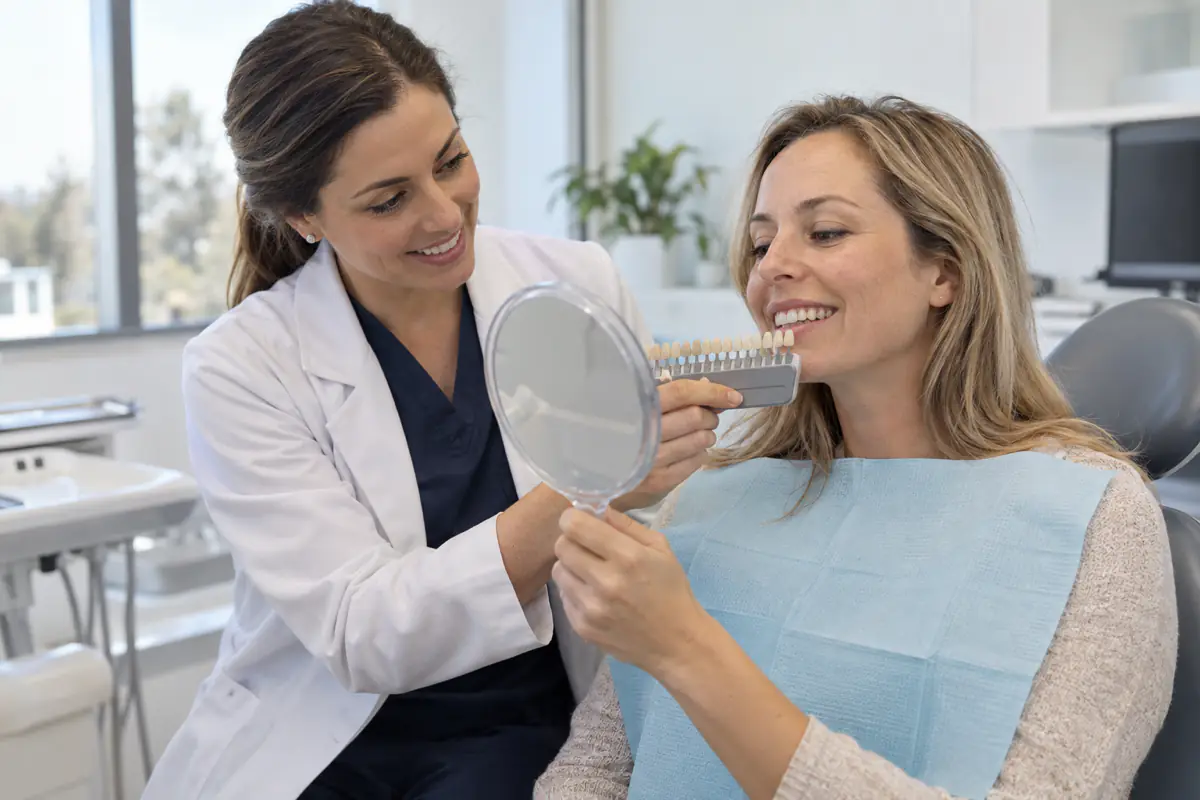
A brighter smile can be a reasonable cosmetic goal, but teeth whitening in Simcoe should begin with an accurate idea of what peroxide can and cannot change. Whitening can lighten many stains within natural enamel and dentin. It cannot remove decay, fix a crack, reposition a tooth or recolour a crown.
The safest plan considers oral health, existing restorations, the cause of discolouration and sensitivity risk. A result that looks healthy and natural is more useful than chasing an artificial paper-white shade that may not be achievable—or flattering—for every smile.
Whitening versus cleaning
A professional cleaning removes plaque, calculus and some surface stain. Teeth may look brighter afterward because deposits from coffee, tea, tobacco or food have been polished away. Cleaning does not chemically lighten the tooth’s internal colour.
Whitening toothpaste mainly uses mild abrasives or surface-stain ingredients. It may help remove external stain but usually does not produce the same change as a peroxide bleaching product. Overly abrasive products can wear exposed roots or increase sensitivity.
Bleaching products contain peroxide that moves through tooth structure and breaks down coloured molecules. Concentration, contact time, delivery method and starting colour all affect the outcome.
Why teeth change colour
Natural tooth shade varies with genetics, enamel thickness and dentin colour. Teeth tend to look darker or yellower as enamel becomes thinner and dentin changes with age. Coffee, tea, red wine, tobacco and strongly pigmented foods add surface stain.
Internal discolouration may follow trauma, certain developmental conditions, old dental materials or medication exposure while teeth were forming. A single dark tooth after injury is different from a generally yellow smile and may need pulp testing before cosmetic care.
Translucent edges, white spots and bands can become more noticeable during whitening because different areas respond at different rates. An examination helps set realistic expectations.
Start with a dental assessment
Whitening over untreated disease can delay needed care or cause unnecessary pain. Before starting, a dentist should consider:
- cavities or leaking restorations;
- cracked or chipped teeth;
- gum recession and exposed roots;
- current sensitivity;
- gum inflammation;
- crowns, veneers, bonding and visible fillings;
- the source and pattern of discolouration; and
- pregnancy, medication and relevant health history.
X-rays are not automatically required solely for whitening, but they may be recommended when symptoms or findings suggest decay, trauma or pulp disease. Cosmetic treatment should follow diagnosis, not replace it.
Professional in-office whitening
In-office whitening uses a higher-concentration product under professional supervision. The gums and soft tissues are isolated, the gel is applied for controlled intervals and the response is monitored. Some systems use a light, while others rely on the chemistry without one; a bright lamp in an advertisement is not proof of better or longer-lasting results.
The main advantage is controlled application and a faster initial change. Sensitivity can still occur, and one appointment does not guarantee a specific shade. Deep or unusual stains may need additional sessions or another cosmetic approach.
The dentist records the starting shade and may photograph the teeth under consistent conditions. Immediately after whitening, dehydration can make teeth appear temporarily lighter, so the stable result is judged later.
Dentist-supervised take-home trays
Custom trays are made from an impression or digital scan and hold whitening gel against the teeth. A close fit limits excess material while allowing treatment over several days or weeks at home.
The dentist selects product strength and wear schedule based on the patient. More gel does not whiten faster; it is more likely to leak onto gums and be swallowed. A small prescribed amount is placed in the relevant part of each tooth compartment.
Clean trays with cool water according to instructions and store them away from heat. Hot water can distort the fit. Keep whitening gel away from children and pets and observe storage and expiry directions.
Over-the-counter strips and products
Whitening strips can lighten suitable natural teeth when used correctly. Their peroxide concentration and fit differ from professional systems. They may not contact rotated teeth or reach every visible surface evenly.
The American Dental Association’s MouthHealthy guidance recommends discussing over-the-counter bleaching with a dentist and looking for products with credible evidence and appropriate acceptance. Follow the labelled schedule exactly.
Avoid unregulated online products that do not clearly disclose ingredients or instructions. Do not combine strips, pens, lights and trays in an attempt to accelerate results. Chemical injury and sensitivity are not signs that the product is working better.
Whitening toothpaste and charcoal
Whitening toothpaste may reduce surface stain through polishing or chemical stain removal. It does not necessarily change intrinsic colour. Select a fluoride toothpaste with a recognized safety and effectiveness standard, especially if cavity risk is present.
Charcoal powder and highly abrasive pastes can remove surface material but may also roughen or wear enamel and exposed roots. Dark particles can lodge around restorations or the gumline. “Natural” does not mean non-abrasive or clinically proven.
Acidic fruit, vinegar, lemon juice and baking-soda mixtures are not safe whitening substitutes. Acid softens enamel, and abrasive scrubbing can remove the softened surface.
Why sensitivity happens
Peroxide can pass through enamel and dentin and temporarily irritate the pulp. Short, sharp cold sensitivity is the most common side effect. Risk may be higher with existing sensitivity, recession, cracks, high concentrations or overly frequent use.
The ADA notes that whitening sensitivity is often temporary and may improve when treatment is delayed and then restarted appropriately. A dentist may suggest a desensitizing fluoride or potassium-nitrate product, reduced contact time or longer intervals.
Stop and seek advice for severe, spontaneous or lingering pain. One tooth that hurts much more than the others may have decay, a crack or pulp inflammation. Our guide to sensitive teeth in Simcoe explains these warning patterns.
Protecting the gums
Whitening gel that contacts gums can cause temporary white patches, burning or soreness. Remove excess gel and rinse as directed. Do not continue applying product to irritated tissue.
Custom trays should be checked if they repeatedly rub or leak. With over-the-counter strips, keep the material on the teeth rather than folding large amounts onto the gum. If ulcers, peeling or prolonged colour change develops, stop and contact a dental professional.
Crowns, veneers, bonding and fillings
Restorative materials do not whiten like natural tooth. A crown that matched before treatment may look darker afterward. This matters most in the front teeth, where even a small shade difference is visible.
Plan the sequence before replacing restorations. Often, natural teeth are whitened first, then allowed to stabilize before a new crown, veneer or filling is shade-matched. Replacing sound dental work only for colour is an irreversible decision with cost and future maintenance.
Whitening also cannot correct the shape, position or translucency of a restoration. Bonding or veneers may be discussed when colour is not the only concern, but those options require their own risk-benefit conversation.
A single dark tooth
A tooth darkened by trauma may have a damaged or dead pulp. It needs vitality testing and possibly X-rays. If root canal treatment is indicated, internal whitening may be considered after the canal is treated and sealed.
Internal whitening places material inside a root-canal-treated tooth under dental supervision. It is different from whitening trays and carries specific risks. A crown or veneer may be an alternative when structure, existing restorations or colour pattern make internal bleaching unsuitable.
Do not repeatedly apply more external product to one dark tooth without diagnosis.
White spots and uneven colour
Early decay, developmental enamel differences and fluorosis can create white or brown areas. Whitening the surrounding tooth may initially make contrast more obvious. As colour stabilizes, the appearance can change, but whitening alone may not blend every spot.
Treatment options can include remineralization, resin infiltration, microabrasion, bonding or veneers depending on cause and depth. A conservative approach begins with diagnosis and the least invasive option that meets the goal.
How white is realistic?
Shade guides contain a range of natural colours, and teeth are not one uniform block. Canines are often slightly warmer than front incisors, while edges may be translucent. Skin tone, lipstick and lighting affect perception.
Digital photos and social-media filters create unrealistic expectations. Whitening cannot guarantee the shade seen on a celebrity or edited screen. Ask the dentist to discuss likely improvement rather than promising an exact endpoint.
Over-whitening can produce sensitivity, gum irritation and an opaque or uneven appearance. Stop at a healthy result rather than continuing because a tray still contains gel.
Keeping results longer
Whitening is not permanent. Coffee, tea, red wine and tobacco can gradually re-stain teeth. Good plaque control and periodic professional cleaning help maintain surface appearance.
Rinse with water after strongly pigmented drinks and avoid holding them around the teeth. A straw may reduce contact for some cold drinks but does not make a sugary or acidic beverage harmless. Tobacco cessation benefits colour and overall oral health.
Do not perform frequent unsupervised touch-ups. Follow the product schedule or a dentist’s plan, and have the mouth reassessed if new sensitivity or restorations develop.
Pregnancy and whitening
Elective whitening can generally wait during pregnancy and breastfeeding because there is little reason to introduce avoidable chemical exposure for a cosmetic procedure during that period. Routine preventive and necessary dental care should continue.
Discuss plans with the dentist and prenatal clinician if you have questions. Do not confuse postponing cosmetic bleaching with postponing treatment for pain, decay or infection.
Questions before choosing a method
Ask:
- Is the discolouration external, internal or both?
- Are there cavities, cracks or gum problems to treat first?
- Which visible restorations will not change colour?
- How much improvement is realistic?
- What sensitivity plan fits my history?
- How should I stop or modify treatment if symptoms develop?
- Will future bonding or crown work need to be delayed until the shade stabilizes?
Clear answers prevent wasted products and mismatched expectations.
Discuss whitening near Simcoe
Port Dover Family Dentistry welcomes patients from Simcoe and across Norfolk County for cosmetic consultations and preventive care. We can identify the type of staining, check oral health and explain options that preserve comfort and a natural appearance.
Call 519-583-2929 or request an appointment to discuss whitening. Bring any product you already use and mention sensitivity, a dark individual tooth or visible crowns and fillings so the plan accounts for them.
About the author
Port Dover Family Dentistry Team
Our team provides family-focused dental care in Port Dover, Ontario. We create practical oral-health education to help patients ask informed questions and feel more confident about care. This article is general information and does not replace an examination or personalized diagnosis.