
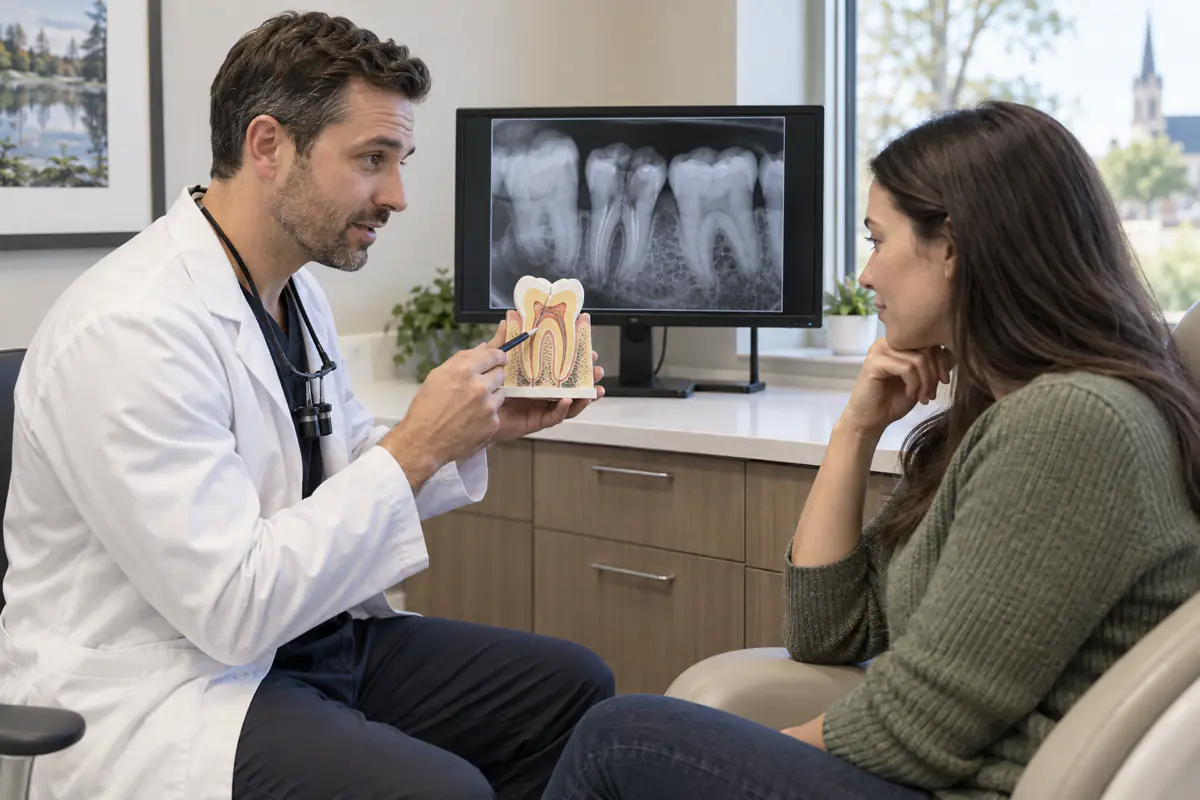
Severe tooth pain can make a decision feel urgent and frightening. When discussing a root canal vs extraction in Simcoe, there is no responsible one-answer rule. Root canal treatment preserves the tooth, while extraction removes it; either may be appropriate depending on whether the tooth can be predictably restored, its supporting tissues and the patient’s priorities.
The best comparison looks beyond the next appointment. It includes the final restoration, healing, future maintenance and what will happen to the space if the tooth is removed. A careful diagnosis turns a pressured choice into an informed plan.
First ask whether the tooth is restorable
Before comparing procedures, the dentist determines what has happened and how much healthy structure remains. Deep decay may extend under the gum. A crack may be limited to the crown or split the root. Bone support may be healthy or substantially reduced by periodontal disease.
A tooth generally needs enough sound structure above the gum to hold a durable restoration. The root and surrounding bone must provide reasonable support, and decay or fracture must be accessible. A technically successful root canal cannot make an unrestorable tooth restorable.
Assessment can include symptoms, cold and percussion tests, gum measurements and dental X-rays. Existing crowns and fillings are examined for leakage or fracture. In complex cases, referral to an endodontist—a dentist with advanced training in root canal diagnosis and treatment—can clarify whether preservation is realistic.
What root canal treatment does
Inside each tooth is a space containing pulp tissue. Deep decay, cracks, repeated procedures or trauma can inflame or infect the pulp. During root canal treatment, the dentist creates an access opening, removes affected tissue, shapes and disinfects the canals, and seals the internal space.
The treated tooth remains in the mouth and continues to function through its root and surrounding ligament. It does not need the pulp to remain attached after maturity. Local anaesthetic is used, and treatment may take one or more visits depending on anatomy, infection and the treatment plan.
The access opening must be restored. Back teeth and teeth with substantial structural loss often need a crown or another cuspal-coverage restoration to reduce fracture risk. This final step is part of the treatment, not an optional cosmetic extra.
The American Association of Endodontists provides an overview of cleaning, filling and restoring the tooth. Individual technique and prognosis vary, so an examination is more useful than comparing your tooth with someone else’s experience.
What an extraction does
Extraction removes the tooth from its socket. A simple extraction may be possible when enough tooth can be grasped. A surgical approach may be needed when a tooth is broken at the gum, roots are curved or surrounding bone must be accessed.
Pressure is expected with local anaesthetic, but sharp pain should not be. After removal, a blood clot forms in the socket and early healing begins. The area may be sore and swollen, and the patient receives instructions about bleeding control, diet, cleaning and activities.
Removing the source can be the right choice for an unsalvageable tooth. It also creates a space and an irreversible change. Unless the position and bite make replacement unnecessary, the next discussion is how that space will be managed.
Situations that may favour saving the tooth
Root canal treatment may be considered when the tooth:
- has infected or irreversibly inflamed pulp but enough structure for restoration;
- has a crack that can be contained and protected rather than a complete split;
- has adequate periodontal support;
- contributes meaningfully to chewing, appearance or an existing dental plan;
- can be cleaned and sealed through accessible canal anatomy; and
- has a prognosis the patient accepts after alternatives are explained.
Preserving a natural tooth avoids creating a new gap and usually avoids preparing adjacent teeth solely to support a bridge. Natural periodontal ligaments also provide sensory feedback during chewing. These benefits matter, but they do not guarantee that every treated tooth lasts for life.
Situations that may favour extraction
Extraction may be more predictable when:
- a vertical root fracture or complete split extends deeply;
- decay reaches so far below the gum or bone that a durable seal cannot be created;
- too little tooth structure remains to retain a restoration;
- advanced periodontal disease has left inadequate support;
- repeated endodontic treatment or surgery cannot reasonably control disease;
- severe resorption, perforation or root anatomy creates a poor prognosis; or
- the tooth’s position and overall treatment plan make retention of little value.
Medical health, ability to undergo procedures, access to follow-up and personal preferences also influence the plan. “Possible” and “predictable” are not the same. Ask the dentist to explain both the technical feasibility and realistic long-term outlook.
Comparing comfort and recovery
Modern local anaesthetic is used for both treatments. Root canal discomfort usually comes from the inflamed tooth and surrounding tissues rather than a myth that treatment must be painful. Tenderness when biting may persist briefly after cleaning, especially when infection was present.
Extraction leaves a healing socket. Bleeding, swelling and soreness often peak early and then improve. The clot must be protected, and smoking, vigorous rinsing or drinking through a straw can raise the risk of a painful dry socket. Surgical difficulty and health factors affect recovery.
Neither path is completely sensation-free, and recovery cannot be predicted from procedure names alone. Ask what level and duration of discomfort are typical for your specific tooth and when worsening symptoms require a call.
Comparing time and number of visits
A straightforward root canal may be completed in one visit, but complex anatomy, retreatment or active drainage can require more. A separate visit for a permanent filling or crown is common. Temporary restorations need protection between appointments.
Extraction itself may be one visit, followed by healing checks when indicated. Replacement can add months and several procedures. An implant often requires bone healing before the final crown, although timing varies. A bridge or partial denture involves its own records, preparation and delivery stages.
Do not compare only “root canal day” with “extraction day.” Compare the complete sequences needed to reach stable function.
The real cost comparison
Fees vary by tooth, complexity, provider, restoration and insurance. A molar root canal plus crown costs more than a simple filling, but an extraction followed by an implant and crown involves a different total. A bridge affects adjacent teeth, and a removable partial denture has maintenance and replacement needs.
Request written estimates for the full likely pathways:
- root canal treatment, core buildup and final restoration;
- extraction alone and the expected effect of leaving the space;
- extraction plus implant, abutment and crown;
- extraction plus fixed bridge; and
- extraction plus removable partial denture, when appropriate.
Coverage is not a clinical verdict. An insurer may reimburse one option differently without determining which has the best prognosis. Ask about limitations, preauthorization and timing, but make the health decision with a clinician who has examined the tooth.
Replacing an extracted tooth
A dental implant is placed in bone and supports a crown without using neighbouring teeth for support. It requires adequate bone, healthy tissues, healing time and ongoing hygiene. Smoking, uncontrolled diabetes, gum disease and some medical factors can affect candidacy and risk.
A fixed bridge uses crowns on neighbouring teeth to support a replacement. It can restore function relatively quickly but requires preparation of those teeth and special cleaning underneath. Its value depends partly on whether those teeth already need crowns.
A removable partial denture can replace one or several teeth and is taken out for cleaning. It is generally less invasive but feels and functions differently from a fixed tooth. In selected situations, leaving a space may be reasonable, but drifting, bite changes and reduced chewing should be discussed first.
Our overview of missing tooth options in Norfolk County compares these paths, and dental implants in Norfolk County explains implant planning in more detail.
What if a root canal has already failed?
Continued symptoms do not automatically mean extraction. A missed canal, leakage under a restoration, new decay or a persistent infection may sometimes be managed with root canal retreatment. Endodontic surgery can address selected problems near the root tip.
The American Association of Endodontists describes retreatment and surgery among options that may preserve a diseased tooth, while acknowledging that extraction is necessary in some cases. An endodontic opinion can be especially helpful before removing a strategically important tooth.
Retreatment is not always appropriate. A vertical root fracture, non-restorable decay or inadequate periodontal support can remain decisive. The goal is not saving a tooth at any cost; it is choosing a defensible treatment with understood risks.
Antibiotics are not a substitute
Antibiotics can help when a dental infection is spreading or producing systemic illness, but they do not remove infected pulp, clean a root canal or repair a split tooth. Symptoms may temporarily ease while the source remains.
Unnecessary antibiotics can cause side effects and contribute to resistance. Take them only when prescribed and complete instructions as directed, but return for the definitive dental care arranged. Swelling can become dangerous even if pain decreases.
Questions to ask before deciding
Bring these questions to the treatment discussion:
- What is the exact diagnosis, and how certain is it?
- Is the tooth restorable after the internal treatment is complete?
- Is there a crack, and where does it extend?
- What is the periodontal support?
- Would specialist assessment change the decision?
- What final restoration will the tooth need, and when?
- What are the realistic risks of root canal treatment, retreatment and fracture?
- If the tooth is extracted, should it be replaced?
- What are the complete timelines and costs for each path?
- What happens if treatment is delayed?
Write down the answers or ask for a copy of the treatment plan. If the tooth is stable enough to wait and the decision is difficult, a second opinion is reasonable. Severe infection or swelling may reduce the safe time available.
When symptoms require urgent care
Call a dentist promptly for spontaneous or throbbing pain, pain that wakes you, facial swelling, a gum pimple, fever, a bad taste or difficulty biting. A cracked or broken tooth that is cutting tissue or cannot tolerate gentle pressure also needs timely assessment.
Seek emergency medical attention for rapidly spreading face or neck swelling, difficulty breathing or swallowing, swelling that affects the eye, confusion or severe illness. Do not wait for an ordinary appointment in those situations.
Avoid placing aspirin, alcohol or caustic products on the tooth. Use pain medicine only when medically safe and follow label directions. A pharmacist can help check interactions and contraindications while you arrange dental care.
Make the decision with complete information
When a tooth can be predictably restored, keeping it is often a valuable goal. When fracture, decay or support makes that outcome unlikely, extraction can prevent repeated procedures with little benefit. The most appropriate choice respects both the clinical evidence and what matters to the patient.
Port Dover Family Dentistry welcomes patients from Simcoe and across Norfolk County for diagnosis, urgent dental concerns and treatment planning. We can review X-rays, explain restorability and arrange specialist input when it would add value.
Call 519-583-2929 or request an appointment to discuss tooth pain or a root canal-versus-extraction recommendation. If swelling is increasing or you feel unwell, call directly and describe those symptoms so the urgency can be assessed.
About the author
Port Dover Family Dentistry Team
Our team provides family-focused dental care in Port Dover, Ontario. We create practical oral-health education to help patients ask informed questions and feel more confident about care. This article is general information and does not replace an examination or personalized diagnosis.