
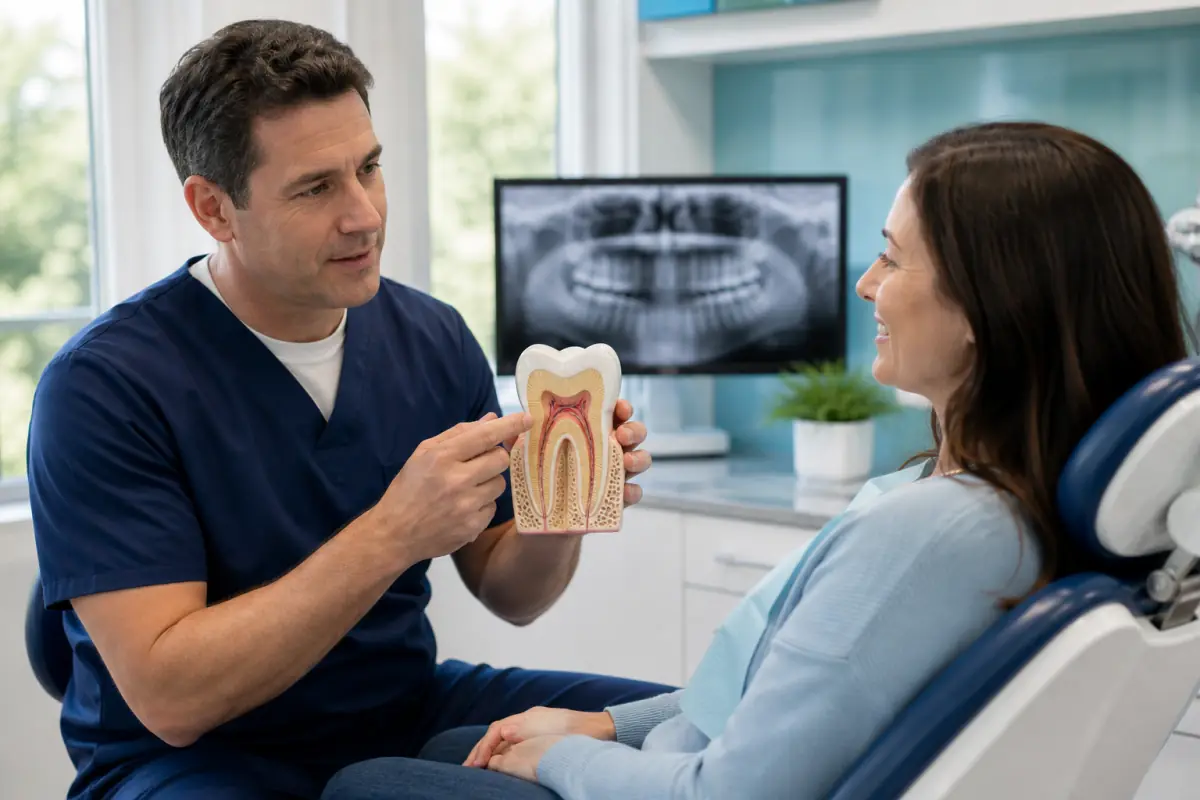
Root canal treatment in Port Dover can preserve a natural tooth when its inner pulp is irreversibly inflamed, infected or no longer vital. Despite its reputation, the procedure is intended to relieve the source of dental pain and prevent infection from continuing—not to create pain.
Symptoms alone cannot confirm that you need a root canal. Cracked teeth, sinus pressure, gum problems and bite issues can feel similar. A diagnosis combines your history, clinical tests and appropriate imaging. This guide helps you understand the process without trying to diagnose yourself.
What is inside a tooth?
Enamel forms the hard outer crown. Beneath it, dentin surrounds the pulp chamber and root canals. Pulp contains nerves, blood vessels and connective tissue that help a tooth develop. Once the tooth is mature, it can function without living pulp because surrounding tissues continue to support it.
Deep decay, cracks, trauma, repeated procedures or leakage can irritate the pulp. Reversible inflammation may settle after the cause is corrected. Irreversible inflammation does not predictably recover; bacteria may then infect the canal system and tissues around the root.
Root canal treatment removes inflamed or infected tissue, disinfects and shapes the internal spaces, then seals them.
Signs that may point to root canal treatment
Possible signs include:
- temperature pain that lingers after the stimulus is gone;
- spontaneous, throbbing or sleep-disrupting pain;
- pain when biting or tapping the tooth;
- gum swelling, a pimple-like drainage point or bad taste;
- facial swelling;
- a tooth that darkens after trauma; or
- deep decay or fracture found during an examination.
Some infected teeth cause little pain. Conversely, sensitivity does not automatically mean the pulp is irreversibly damaged. Contact a dentist rather than waiting for pain to prove severity.
Fever, rapidly spreading swelling, trouble breathing or trouble swallowing require urgent medical attention. Review our Port Dover dental emergency guide for safe triage.
How root canal problems are diagnosed
The dentist asks when symptoms began, what triggers them, how long they last and whether the tooth has been injured or restored. Testing may include cold, heat, tapping, biting, palpation and comparison with nearby teeth. Periodontal measurements can help identify cracks or gum-related causes.
Dental x-rays show roots, bone and some decay, but not every crack. A three-dimensional scan or specialist assessment may be indicated in complex cases. The diagnosis should describe both the pulp condition and tissues around the root.
Ask the dentist to explain what findings support treatment and whether monitoring, restoration or another option is reasonable.
What happens during root canal treatment?
Anaesthesia and isolation
Local anaesthetic numbs the area. A rubber dam usually isolates the tooth, protects the airway and keeps saliva bacteria away from the canals.
Access and tissue removal
An opening is made through the biting surface or back of the tooth. Small instruments remove pulp tissue and shape canals. Molars often have several canals with complex anatomy.
Cleaning and disinfection
Irrigating solutions help disinfect areas instruments cannot fully contact. The objective is microbial control, not simply removing the nerve.
Filling the canals
Cleaned canals are sealed with a biocompatible filling material. The access opening receives a temporary or permanent restoration.
Final tooth restoration
The tooth needs a reliable coronal seal. Many posterior teeth require a dental crown or onlay because decay and access have weakened the cusps. Delaying the final restoration can increase fracture or leakage risk.
Treatment may take one or more visits depending on anatomy, infection, symptoms, retreatment and restoration plans.
Does a root canal hurt?
Modern local anaesthesia makes treatment manageable for most patients. A severely inflamed tooth can sometimes be harder to numb, so tell the dentist what you feel; supplementary techniques may be used.
Tenderness after treatment is possible because tissues around the root may already be inflamed and instruments work near that area. Follow specific aftercare and medication guidance. Do not chew hard on a tooth with a temporary restoration.
Contact the office for severe or worsening pain, increasing swelling, fever, an allergic reaction, a lost temporary filling or a bite that feels very high.
Root canal versus extraction
Root canal treatment aims to preserve the natural tooth. Extraction removes it and may create a need to discuss replacement.
| Consideration | Root canal treatment | Extraction |
|---|---|---|
| Tooth remains | Yes | No |
| Main goal | Disinfect and preserve | Remove source and tooth |
| Final restoration | Often filling or crown | Healing plus possible replacement |
| Future needs | Maintenance and monitoring | Denture, bridge, implant or no replacement |
| Suitability | Requires restorable tooth | May be necessary if tooth cannot be restored |
Saving is not always possible. A vertical root fracture, severe structural loss, inadequate bone support or uncontrolled disease may make extraction more predictable. Conversely, extracting a restorable tooth solely to avoid root canal treatment can introduce replacement costs and changes in chewing.
Root canal treatment and antibiotics
Antibiotics do not remove infected pulp or clean a root canal. The ADA’s evidence-based guideline recommends dental procedures rather than antibiotics alone for many pulpal and localized infections in otherwise healthy adults. Antibiotics are used when clinically indicated, such as certain infections with systemic involvement.
Never use leftover medication or someone else’s prescription. Improvement while taking an antibiotic can be temporary if the source remains.
How successful is root canal treatment?
Many treated teeth function for years, but no procedure is guaranteed. Outcome depends on diagnosis, anatomy, infection, cracks, technical quality, final restoration, periodontal support and ongoing care.
Failure or new disease can result from untreated anatomy, leakage, recurrent decay, fracture or persistent bacteria. Options may include retreatment, root-end surgery or extraction. An endodontist specializes in pulp and root canal conditions and may be recommended for complex anatomy, calcified canals, retreatment or diagnostic uncertainty.
Caring for a root canal-treated tooth
- Complete the final restoration promptly.
- Avoid hard chewing until the dentist confirms the tooth is protected.
- Brush twice daily with fluoride toothpaste.
- Clean between the tooth and neighbours daily.
- Reduce frequent sugar exposure.
- Address grinding or clenching.
- Attend follow-up radiographs when recommended.
- Report new pain, swelling, looseness or a restoration fracture.
The tooth can no longer feel temperature through its pulp, but tissues around the root still sense pressure and inflammation. It can develop decay like any other tooth.
What if the tooth stops hurting before treatment?
Pain can stop when pulp tissue dies, while infection continues into the canal and bone. A quiet tooth is not necessarily a healed tooth. If root canal treatment was recommended, ask before cancelling because symptoms disappeared.
Likewise, an abscess may drain through the gum and reduce pressure. The drainage point indicates a pathway from infection and requires assessment.
Can root canal treatment cause illness?
Claims that properly treated root canal teeth routinely cause systemic disease are not supported by modern evidence. Root canal treatment is a standard procedure used to control infection and preserve teeth. Online content that recommends removing every treated tooth often misrepresents old research.
Like any treatment, root canal therapy has limitations and can fail. Evaluation should focus on current clinical findings, not fear-based claims.
Cost and CDCP coverage in Port Dover
Fees vary by tooth because front teeth, premolars and molars have different numbers and complexity of canals. Retreatment and specialist care can also differ. The final filling or crown is a separate part of the plan.
Current CDCP coverage information includes root canal services when program policies and tooth eligibility criteria are met. Standard treatment on many teeth may not require preauthorization, while retreatment and some third molars do. Co-payments and additional charges can apply.
Ask for estimates for both the root canal and final restoration. Treating the inside without sealing and strengthening the outside leaves the plan incomplete.
Questions to ask before treatment
- What is the pulp and root diagnosis?
- Is the tooth restorable after treatment?
- Is a crack suspected?
- What are the alternatives and their trade-offs?
- Should an endodontist treat this tooth?
- How many visits are expected?
- What final restoration will be needed?
- What symptoms require an urgent call?
Root canal care at Port Dover Family Dentistry
At Port Dover Family Dentistry, we assess painful and damaged teeth, explain whether root canal treatment is appropriate and arrange specialist referral when complexity calls for it. Our priority is a diagnosis you understand and a complete plan for function afterward.
For root canal treatment in Port Dover, call 519-583-2929 or request an appointment. If swelling is spreading or breathing or swallowing is affected, seek emergency medical care immediately.
Frequently asked questions
How long is recovery?
Many people return to normal activity quickly, while biting tenderness may last several days. Recovery depends on infection and treatment complexity. Follow individual instructions.
Can a root canal tooth get another cavity?
Yes. Enamel and dentin remain vulnerable to plaque acids, especially at restoration margins. Daily fluoride brushing and monitoring remain necessary.
Why was I referred to an endodontist?
Referral may reflect curved or calcified canals, retreatment, complex diagnosis, trauma or specialized equipment needs. It supports predictability rather than indicating something went wrong.
About the author
Port Dover Family Dentistry Team
Our team provides family-focused dental care in Port Dover, Ontario. We create practical oral-health education to help patients ask informed questions and feel more confident about care. This article is general information and does not replace an examination or personalized diagnosis.