
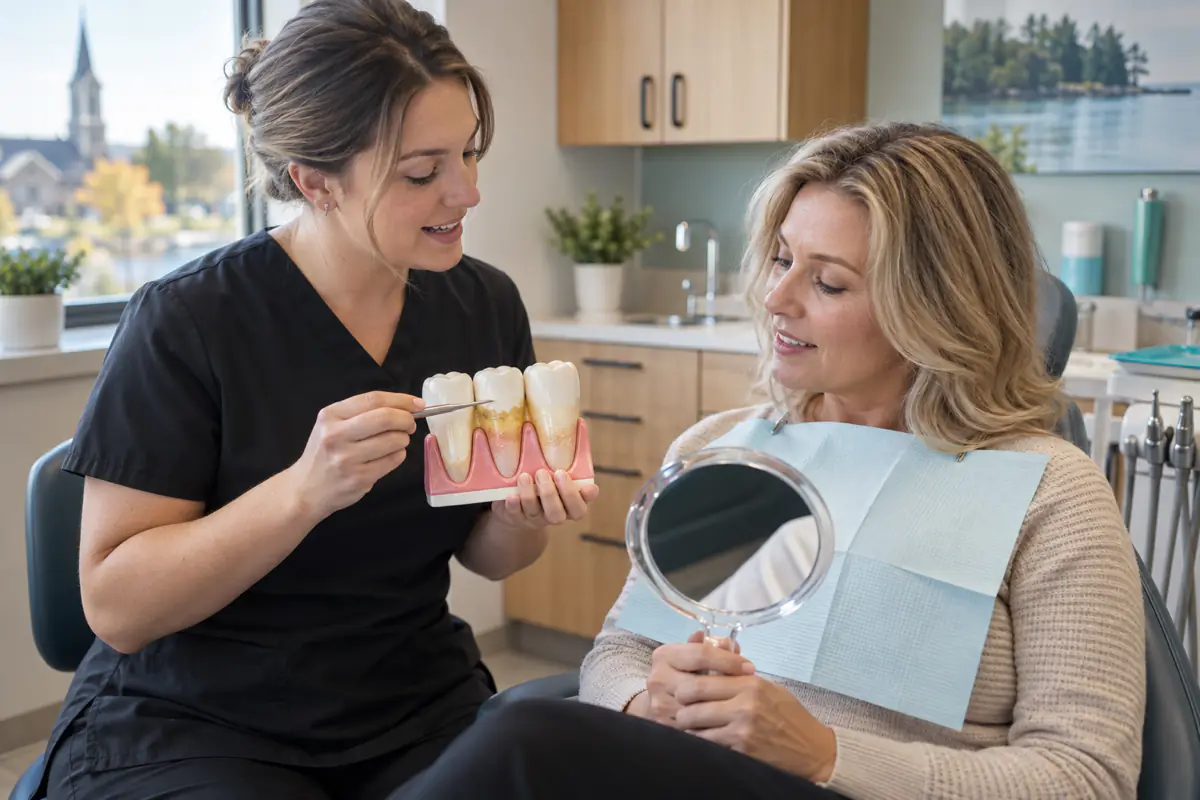
The terms plaque and tartar are often used interchangeably, but they are not the same material. Understanding plaque vs tartar in Simcoe helps explain why daily brushing matters and why even careful brushers still need professional assessment and cleaning.
Plaque is a soft, living biofilm that continually reforms. Tartar—also called calculus—is plaque that has absorbed minerals and hardened onto a tooth or restoration. You can disrupt plaque at home. Once a deposit becomes calculus, a toothbrush cannot safely lift it away.
What dental plaque is
Plaque is an organized community of bacteria held in a sticky matrix. It attaches to teeth, fillings, crowns, dentures, implants and orthodontic appliances. It begins forming again soon after cleaning, even if you have not eaten.
Fresh plaque may be colourless or pale, so a tooth can look clean while biofilm remains along the gumline. With time, the community matures and becomes harder to disrupt. Food debris may be trapped in plaque, but plaque is not simply leftover food.
Effective home care does not sterilize the mouth. The goal is to disturb the biofilm regularly so it does not remain organized long enough to drive decay and gum inflammation.
How plaque contributes to cavities
Certain plaque bacteria use sugars and starches from food and drinks and produce acids. These acids lower the pH next to enamel, drawing out minerals. Saliva helps neutralize acid and return minerals between exposures.
Frequent sipping or snacking shortens the recovery time. Repeated mineral loss can create a chalky white area and eventually a cavity. The location often reflects plaque retention: between teeth, around brackets, near the gumline or beside a restoration.
Removing plaque and reducing the frequency of fermentable carbohydrates both matter. Brushing harder cannot fully compensate for sweet drinks consumed over many hours.
How plaque affects gums
Plaque along the gumline triggers an inflammatory response. Gums may become red, puffy and bleed during brushing or flossing. This early stage, gingivitis, can often improve when plaque is removed effectively and hardened deposits are professionally cleaned.
In susceptible people, inflammation may progress into periodontitis, damaging the attachment and bone that support teeth. Smoking, diabetes, genetics and other health factors influence risk and healing.
Bleeding is not a reason to abandon cleaning. It is a reason to improve gentle technique and arrange an assessment if it persists.
How plaque becomes tartar
When plaque remains, calcium and phosphate from saliva and gum fluid can mineralize it. The deposit becomes hard and firmly attached. It may happen above the gumline or within a periodontal pocket.
Calculus above the gumline is often cream or yellow. Below the gum, it can look brown or black because of pigments from blood and other fluids. Colour alone does not show how much damage exists.
The rough surface of calculus retains new plaque, making daily cleaning more difficult. Calculus does not independently explain every case of gum disease, but it creates a protected surface where inflammatory biofilm can persist.
Where tartar commonly collects
Tartar often accumulates behind the lower front teeth, near ducts from the salivary glands. The cheek sides of upper back teeth are another common location. Crowded teeth, fixed retainers, braces and rough restoration margins create additional sheltered areas.
Some people form heavy deposits quickly despite reasonable home care. Saliva chemistry and flow differ between individuals. Others form little visible tartar but still retain plaque between teeth or beneath the gum.
Do not use the amount of tartar you can see as the only measure of oral health. A periodontal examination provides a more complete picture.
Can you feel the difference?
Plaque can make teeth feel fuzzy when you run your tongue over them. Tartar may feel like a hard ledge or rough shell, particularly behind lower incisors. Neither sensation is a diagnostic test.
A smooth surface can still have early decay or plaque between teeth. A rough spot might be calculus, a chipped filling, exposed root, enamel shape or hardened bonding material. Avoid scraping it to find out.
If a new sharp or rough area persists after brushing, ask a dental professional to inspect it.
Why brushing removes plaque but not tartar
Toothbrush bristles can sweep and disrupt a soft biofilm. Floss, interdental brushes and water flossers help reach surfaces the brush misses. Hardened calculus is bonded to microscopic irregularities and needs controlled scaling with professional instruments.
Trying to chip it away with metal picks purchased online can cut gums, scratch roots and restorations, or leave deposits below the surface. A piece may break off while deeper buildup remains.
The NIDCR oral-hygiene guide states that only a dentist or dental hygienist can remove tartar. Home care is essential for limiting its return after professional cleaning.
What happens during scaling
The hygienist or dentist examines the mouth and chooses hand scalers, ultrasonic instruments or both. Ultrasonic tips vibrate and use water to disrupt deposits and flush the area. Hand instruments provide tactile control around contours and beneath the gumline.
Scaling should be adapted to the amount and location of buildup, tissue health, sensitivity and medical history. Some people need only routine deposit removal. Others with periodontal disease require deeper instrumentation, local anesthetic or more than one visit.
Tell the clinician if a tooth is sensitive or if you take medicine affecting bleeding. Comfort options can be discussed before treatment.
Scaling, polishing and whitening are not the same
Scaling removes plaque and calculus. Polishing uses a fine paste or air-polishing medium to remove selected surface stain and smooth accessible areas when appropriate. Whitening changes colour molecules within tooth structure using peroxide-based products.
A cleaning may brighten teeth by removing coffee, tea or tobacco stain, but it does not bleach the natural shade. Conversely, whitening does not remove calculus or treat inflamed gums.
If appearance is your main concern, begin with an examination and cleaning. Healthy tissues and clean surfaces make cosmetic planning safer and more predictable.
Why gums may bleed after a cleaning
Inflamed gums can bleed during and shortly after scaling because fragile tissue is being touched and deposits are removed. Mild tenderness can occur when heavy tartar had covered a sensitive root or filled spaces between teeth.
Symptoms should improve as inflammation settles and home cleaning continues. Contact the office for persistent heavy bleeding, increasing swelling, fever or pain that does not follow the expected course.
Do not stop brushing for days after cleaning. Use a soft brush and the technique recommended by your hygienist.
A realistic plaque-control routine
Brush twice daily with fluoride toothpaste, including the gumline and back surfaces. Use a soft brush that fits comfortably. Light, deliberate pressure is more effective and safer than aggressive scrubbing.
Clean between teeth daily with floss, interdental brushes, a water flosser or another tool suited to your spaces and dexterity. An interdental brush should fit without force. Floss should curve around the tooth rather than snap straight into the gum.
The ADA’s general oral-health recommendations emphasize twice-daily fluoride brushing, daily interdental cleaning, limiting sugar and regular dental care. Your dental team can adjust that framework to your risk.
Do plaque-disclosing products help?
Disclosing tablets or liquids stain retained plaque temporarily, making missed areas visible. They can be valuable for learning, especially around braces or for children developing independence.
Follow product directions, protect clothing and understand that stain on the tongue and lips may last briefly. Disclosure identifies where plaque remains; it does not measure periodontal destruction or replace an examination.
Use the result to change brush angle or tool selection rather than brushing harder everywhere.
Mouthwash has a limited role
Therapeutic mouthrinses can support plaque, gingivitis or cavity control for selected patients. Cosmetic rinses mainly freshen breath. Neither type mechanically removes calculus, and a rinse does not consistently clean beneath an established biofilm.
Some formulas contain alcohol or ingredients that irritate dry or sensitive mouths. Prescription rinses have specific indications and time limits. Ask which product, if any, fits your needs.
If breath changes persist despite cleaning, investigate gum disease, dry mouth, decay and non-dental causes rather than continually masking the odour.
Braces, retainers and dental work
Brackets, fixed retainers, bridges and implant restorations create additional plaque-retentive surfaces. The correct tool depends on the design. Floss threaders, small interdental brushes, end-tuft brushes and water flossers may improve access.
Clean removable retainers and dentures separately according to professional instructions. Do not use boiling water or abrasive household cleaners that can distort or scratch them.
Implants cannot develop cavities, but plaque around them can inflame surrounding tissues and contribute to bone loss. They still require home care and professional monitoring.
Dry mouth changes the equation
Saliva buffers acids, supplies minerals and helps clear food. Medicines, dehydration, radiation therapy and health conditions can reduce flow. With less saliva, plaque-related decay may advance more quickly, especially on exposed roots.
Sip water, avoid frequent sweet or acidic lozenges and ask about saliva substitutes or sugar-free gum if safe. A dentist may recommend additional fluoride and shorter examination intervals.
Do not stop prescribed medicine because of dry mouth without speaking to the prescriber. Medication timing or alternatives may sometimes be adjusted medically.
Tobacco and plaque-related disease
Smoking increases periodontal risk and can make treatment less successful. It may also suppress obvious bleeding, so gums can look less inflamed than the underlying disease would suggest. Smokeless tobacco exposes tissues to additional irritation and cancer risk.
Dental care should include supportive, non-judgmental cessation advice. Even after years of use, stopping benefits oral and general health.
Vaping is not a plaque-control strategy and is not harmless to oral tissues. Tell the dentist what products you use so risk assessment is accurate.
How often should tartar be removed?
There is no one schedule for everyone. The interval depends on how quickly deposits form, gum health, pocket depth, home care, restorations, smoking, diabetes and previous periodontal disease.
Some people remain stable with a routine preventive interval. Others need periodontal maintenance more often after active treatment. The reason should be explained and reviewed over time.
Do not wait for visible chunks of tartar or bleeding. Deposits below the gumline may not be visible in a mirror.
Common plaque and tartar myths
“If my teeth feel smooth, they are disease-free.” Smoothness cannot rule out decay between teeth or gum disease.
“A hard toothbrush removes tartar.” It can traumatize gums and wear exposed roots while calculus remains attached.
“Only people with poor hygiene form tartar.” Home care strongly influences buildup, but saliva, anatomy, appliances and health also matter.
“Bleeding means I should stop flossing.” Persistent bleeding usually calls for better gentle cleaning and professional assessment, not indefinite avoidance.
“A cleaning loosens teeth.” Advanced gum disease and bone loss cause mobility. Removing deposits can reveal spaces or movement that tartar had concealed; it does not create healthy support loss.
Professional cleaning near Simcoe
Port Dover Family Dentistry provides examinations, hygiene care and periodontal assessment for patients from Simcoe and surrounding Norfolk County communities. We can identify where plaque and calculus are collecting, measure gum health and recommend tools that fit your mouth.
Call 519-583-2929 or request an appointment. If your gums are bleeding, receding or sore, our guides to gum disease prevention and gum recession in Simcoe offer additional background.
Frequently asked questions
Why did a piece of tartar fall off?
A fragment can break away, leaving a rough edge or exposing a space. Do not scrape the rest. Book a cleaning so all surfaces, including below the gumline, can be assessed.
Does tartar-control toothpaste remove existing calculus?
No. Some ingredients can reduce the rate at which new tartar forms, but they do not detach existing deposits. Professional scaling is still required.
Can children develop tartar?
Yes. Children can form calculus, particularly around crowded teeth, orthodontic appliances or areas they miss. Technique coaching and a dental assessment help identify the cause and appropriate schedule.
About the author
Port Dover Family Dentistry Team
Our team provides family-focused dental care in Port Dover, Ontario. We create practical oral-health education to help patients ask informed questions and feel more confident about care. This article is general information and does not replace an examination or personalized diagnosis.