
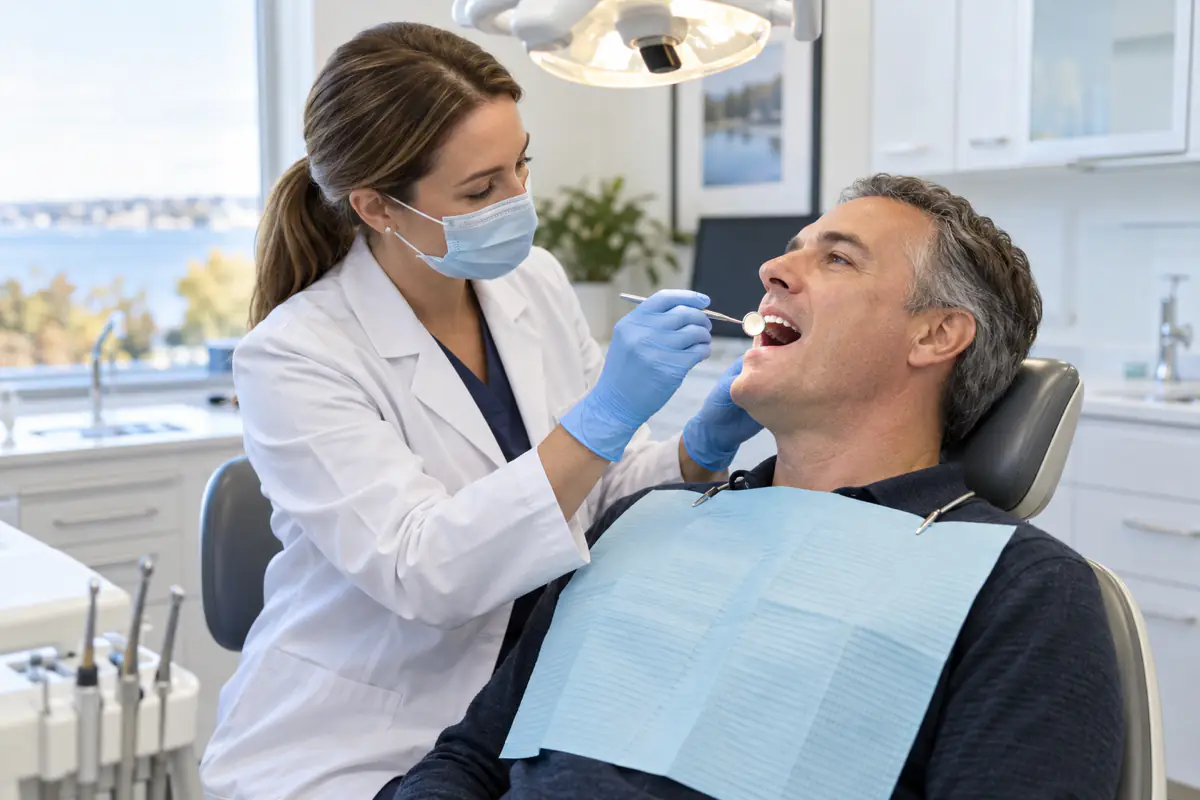
An oral cancer screening in Simcoe is a brief examination of the lips, mouth, tongue, throat and nearby tissues for changes that may need follow-up. It is often incorporated into a dental checkup, but it can also be performed when a patient reports a sore, lump, colour change or swallowing concern.
Most mouth changes are not cancer. Bites, burns, infections and irritated dentures are far more common. Screening is valuable because appearance alone cannot always distinguish a harmless lesion from one that requires referral. Finding a suspicious area is the start of investigation, not a diagnosis.
What “oral cancer” includes
Oral cavity cancers can arise on the lips, inner cheeks, gums, floor of the mouth, front portion of the tongue and hard palate. Oropharyngeal cancers occur farther back, including the base of the tongue, tonsillar area and throat.
These regions have different risk patterns and can be difficult to inspect fully. A dentist can see and feel much of the oral cavity, while some throat structures require a physician or ear, nose and throat specialist. A normal dental examination cannot guarantee that every cancer is absent.
The National Institute of Dental and Craniofacial Research notes that oral cancers can develop on the tongue, mouth lining, gums, under the tongue, at the tongue base and in the back of the throat. Early evaluation matters because these diseases can spread.
What happens during the examination
The clinician first asks about symptoms and risk factors. Remove lipstick and removable dentures so tissues can be seen. During a conventional exam, the dentist or hygienist may:
- inspect the face and lips for asymmetry, sores or colour changes;
- look inside the cheeks and along the gums;
- examine the roof and floor of the mouth;
- move or hold the tongue gently to inspect its sides and underside;
- view as much of the back of the mouth and throat as possible;
- feel the tongue, floor of the mouth and other tissues for firmness;
- palpate the jaw and neck for enlarged nodes or masses; and
- check whether dentures rub or tissue has changed underneath them.
The examination is generally painless. Gauze, a mirror, bright light and gloved hands are ordinary tools. Tell the clinician if a spot is tender or if gagging makes part of the exam difficult.
Changes that deserve attention
Arrange assessment for:
- a sore or ulcer that does not heal;
- a white, red or mixed red-and-white patch;
- a lump, thickened area or rough spot;
- unexplained bleeding or persistent pain;
- numbness of the tongue, lip or another area;
- difficulty chewing, swallowing or speaking;
- persistent hoarseness or a feeling that something is caught in the throat;
- reduced tongue or jaw movement;
- a neck lump;
- one-sided ear pain without an ear explanation; or
- a denture that suddenly fits poorly because the jaw or tissue has changed.
NIDCR advises seeing a dentist or doctor when such symptoms last more than two weeks. That timeframe helps separate minor injuries that heal from persistent changes, but it is not a reason to wait if symptoms are severe, growing or worrying.
A mouth ulcer is not automatically cancer
Canker sores, cheek bites, a sharp tooth, hot-food burns and denture irritation commonly cause ulcers. Many heal once the cause is removed. Location, border, texture, duration and risk history help the clinician decide what comes next.
Do not repeatedly apply caustic products to make a sore disappear. Chemical burns can obscure the original appearance. Avoid adjusting a sharp tooth or denture yourself. Photographing the area with the date can help document change, but a photograph cannot replace palpation or referral.
Our guide to canker sores versus cold sores in Norfolk County explains common differences while emphasizing when persistent lesions need care.
Tobacco and alcohol
Smoking cigarettes, cigars or pipes and using smokeless tobacco raise oral cancer risk. Heavy alcohol use is another major factor, and combined tobacco and alcohol exposure raises risk more than either alone.
Vaping and cannabis smoke are not harmless to oral tissues, even though their long-term cancer-risk evidence differs from conventional tobacco. Tell the clinician what you use and how often. Accurate information improves assessment and creates an opportunity for cessation support without judgment.
Quitting tobacco reduces risk over time and benefits gums, healing, breath and general health. A dentist, pharmacist or physician can help identify counselling and medication options.
HPV and throat cancer
Certain types of human papillomavirus, especially HPV-16, are associated with cancers of the oropharynx. These cancers may occur in people without a tobacco history and can present as a neck lump, persistent sore throat, swallowing difficulty or one-sided ear pain.
A visual dental examination cannot test the entire throat for HPV-related cancer. There is no routine oral HPV swab that reliably predicts who will develop cancer. Persistent throat or neck symptoms may require medical or ear, nose and throat evaluation.
HPV vaccination can prevent infection with high-risk types and is an important public-health measure. Ask a physician or pharmacist about eligibility under current Ontario recommendations rather than using oral screening as a substitute for vaccination.
Sun exposure and the lips
Long-term ultraviolet exposure can contribute to lip cancer, particularly on the lower lip. People who work outdoors, fish, farm or spend substantial time on the water should use a lip balm with sun protection and reapply it as directed.
Watch for a persistent scaly area, crust, ulcer or colour change on the lip. Ordinary chapping should improve with protection and moisturization. A repeatedly bleeding or non-healing spot deserves examination.
Wide-brimmed hats and avoiding peak sun add protection. Lip sunscreen is useful in winter as well as summer because reflected light and outdoor exposure continue.
Age and other risk factors
Risk rises with age, but oral and oropharyngeal cancers can occur in younger adults. A person should not dismiss a persistent lesion because they are “too young” or do not smoke.
Other factors can include immune suppression, previous head and neck cancer, poor nutrition and certain inherited conditions. A personal cancer history changes the level of follow-up. Share previous biopsies, radiation and surgery with the dental team.
Risk factors help set suspicion; they do not diagnose disease. Many tobacco users never develop oral cancer, and some affected patients have no obvious traditional factor.
What happens if something unusual is found
The dentist documents size, location, colour, texture and symptoms. Photographs may establish a baseline. If there is an obvious source of trauma, such as a sharp denture edge, it may be corrected and the tissue rechecked after a short interval.
An unexplained, persistent or concerning area is referred to an oral and maxillofacial surgeon, oral medicine specialist, ear, nose and throat physician or another appropriate clinician. Urgency depends on appearance and symptoms.
A biopsy removes all or part of the tissue for microscopic examination by a pathologist. It is the definitive way to determine whether cells are cancerous, precancerous or benign. Do not interpret referral as proof of cancer; it means the finding deserves an answer.
Adjunctive lights, dyes and rinses
Some practices use special lights, dyes or rinses to highlight tissue differences. These tools may assist examination in selected situations, but they do not replace a complete visual and tactile exam or biopsy.
Inflammation and benign changes can produce positive findings, while cancer can still be missed. Ask what an adjunct is intended to show, what evidence supports it, whether there is an added fee and how the result would change management.
The central steps remain history, conventional examination, documentation and appropriate referral.
Screening and evidence limitations
“Screening” technically means looking for disease in people without symptoms. Evidence about whether population-wide oral screening reduces mortality is not the same as evidence that a persistent lesion should be ignored. Symptomatic or suspicious changes require diagnostic assessment.
No screening test is perfect. False reassurance can delay care, while false alarms can cause anxiety and unnecessary procedures. A normal exam today does not cover a new sore that develops next month.
For this reason, patients share the monitoring role. Know the usual appearance of your mouth and report change rather than relying only on an annual event.
A simple monthly self-check
A self-check cannot diagnose disease, but it can help you notice persistence. In good light:
- Look at the lips and front gums.
- Pull each cheek aside.
- Lift the tongue to view the floor of the mouth.
- Move the tongue left and right to see its sides.
- Note sores, patches or lumps and the date.
- Feel the neck gently for a new persistent lump.
Do not scrape, squeeze or repeatedly poke an area. Colour varies normally, and salivary glands and bone contours can feel like lumps. If something is new or uncertain, ask a professional.
Dentures and oral tissue
Remove dentures daily and inspect the tissue underneath. A poorly fitting denture can create an ulcer, but continued irritation should not simply be covered with more adhesive. The denture and mouth need assessment.
Leave dentures out for sleep unless specifically directed otherwise, and clean them with suitable products. A fungal infection can create red or white changes and may require treatment. A sore that remains after fit correction still needs follow-up.
See denture sore spots in Simcoe for temporary comfort measures and signs of poor fit.
Prevention beyond screening
Screening does not prevent cancer. Risk reduction includes avoiding tobacco, limiting alcohol, protecting lips from ultraviolet exposure, eating a balanced diet and receiving recommended HPV vaccination.
Maintain dental visits so changes can be compared over time, but seek care between appointments when symptoms arise. Provide a complete health history and tell the clinician about swallowing, voice, throat and ear symptoms—not only tooth pain.
If cancer treatment is planned, a dental assessment before therapy can address infection and reduce complications. The oncology team and dentist should coordinate timing.
When care is urgent
Call a dentist or physician promptly for a rapidly enlarging lump, unexplained bleeding, progressive swallowing difficulty, significant pain or a persistent neck mass. Difficulty breathing or inability to swallow saliva requires emergency medical care.
Do not wait two weeks when symptoms are worsening quickly. Conversely, a harmless-looking sore that quietly persists beyond about two weeks still deserves assessment.
Arrange oral screening near Simcoe
Port Dover Family Dentistry welcomes patients from Simcoe and throughout Norfolk County. Oral soft-tissue examination is an important part of comprehensive dental care, and we can document changes and arrange referral when a finding needs specialist evaluation.
Call 519-583-2929 or request an appointment if you have a persistent sore, patch, lump, numb area or denture-related change. Mention neck swelling, swallowing difficulty or rapid progression when booking so the urgency can be assessed.
About the author
Port Dover Family Dentistry Team
Our team provides family-focused dental care in Port Dover, Ontario. We create practical oral-health education to help patients ask informed questions and feel more confident about care. This article is general information and does not replace an examination or personalized diagnosis.