Choosing missing tooth replacement in Norfolk County is less about finding one “best” treatment than matching the right design to the person. A front-tooth space that affects speech and confidence creates different priorities from a missing back molar. The health of the gums, neighbouring teeth, bone and bite all shape what is realistic.
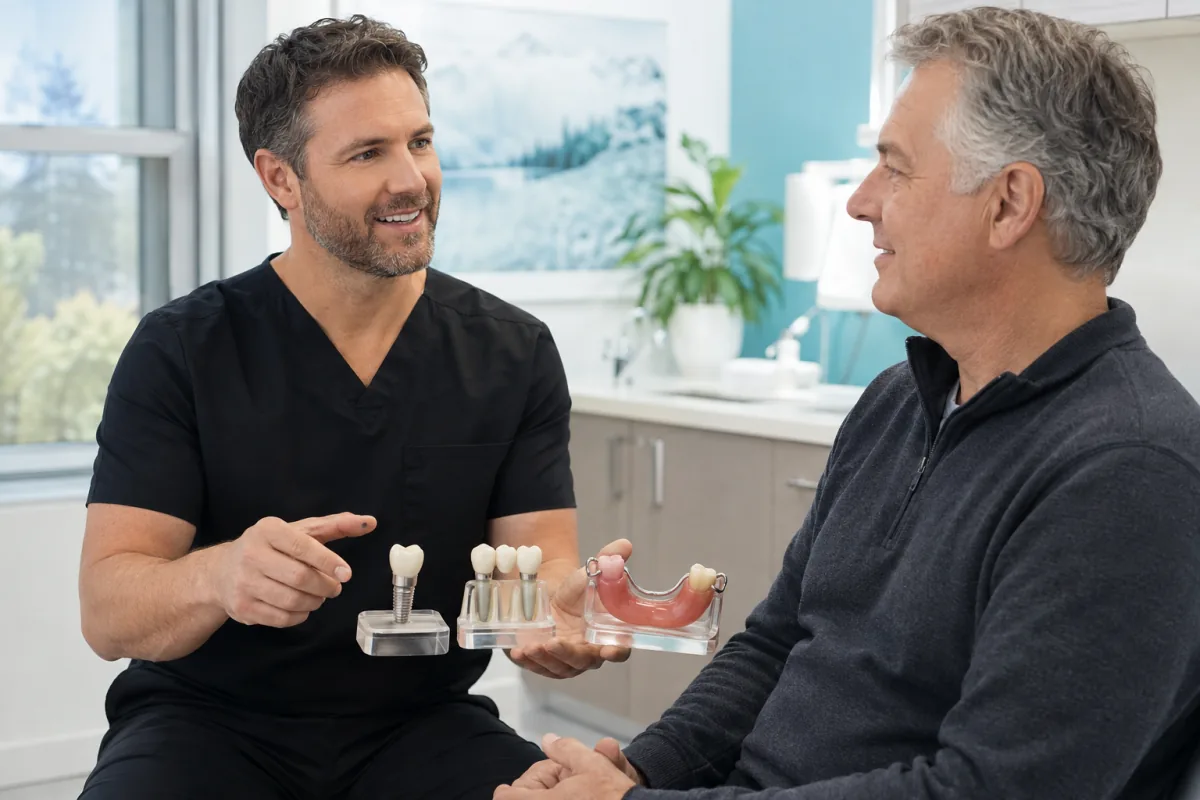
Patients in Port Dover, Simcoe, Waterford, Delhi and nearby communities commonly compare four paths: leave the space, use a removable partial denture, place a fixed bridge or consider a dental implant. Each has benefits, limits and long-term maintenance. A useful consultation should explain all reasonable choices, including the choice not to replace the tooth immediately.
What changes after a tooth is lost?
The jawbone no longer receives force through that tooth root and gradually remodels. The ridge often becomes narrower and lower, especially early after extraction. Neighbouring teeth may tip or drift, and an opposing tooth may move into the space, although the amount varies.
Chewing can shift to the other side. This does not mean the remaining teeth will instantly fail, but it can alter force and food choices. A visible gap may affect speech or confidence. Food can also pack around tilted teeth.
These changes are one reason to discuss future replacement before an extraction when possible. Planning may influence whether socket-preservation grafting or a temporary tooth is appropriate. It does not mean everyone must decide immediately.
Option one: leave the space
Monitoring a space can be reasonable when it is not visible, chewing remains comfortable, the bite is stable and treatment burden outweighs benefit. It avoids surgery, tooth preparation and appliance care.
The limitation is that future change is possible. Bone loss can make later implant placement more complex, and movement of adjacent teeth can reduce space. The dentist should monitor the bite, gum health and opposing tooth.
“No replacement” is still a clinical decision with follow-up, not neglect. Ask what changes would make treatment advisable later.
Option two: removable partial denture
A partial denture has replacement teeth attached to an acrylic or metal framework. It is inserted and removed by the patient and may replace several teeth in different parts of an arch.
Potential advantages include a lower initial cost, no implant surgery and the ability to replace several teeth with one appliance. It can often be modified if another tooth is lost, depending on the design.
Limitations include movement, bulk, visible clasps, food trapping and an adjustment period for speech and chewing. Supporting teeth and gums carry force and must be cleaned carefully. A partial should be removed for daily cleaning and usually overnight, according to professional instructions.
A lower price does not eliminate maintenance. Clasps can loosen, acrylic can fracture and the mouth changes over time. Dentures in Port Dover explains fit, cleaning and repair in more detail.
Option three: fixed dental bridge
A conventional bridge uses crowned teeth on either side of a gap to support an artificial tooth between them. It stays in the mouth and can restore appearance and chewing without implant surgery.
A bridge may be especially reasonable when adjacent teeth already need crowns. Treatment is usually completed faster than a staged implant. The patient does not remove it, but must clean underneath with a threader, small brush or water flosser.
The main tradeoff is preparation of neighbouring teeth. Those support teeth carry the restoration and can still develop decay, gum disease or nerve problems. If one support fails, the whole bridge may be affected.
A cantilever bridge is supported on one side only and suits limited situations. A resin-bonded bridge uses wings bonded behind adjacent teeth and can be conservative for selected front-tooth spaces, but bite and enamel availability determine whether it is predictable.
Read our dental bridges service page for the practice overview.
Option four: dental implant
An implant is a biocompatible post placed in the jawbone to support a crown. It replaces a missing tooth without preparing neighbours for crowns and transfers chewing force to the site.
Treatment requires adequate bone and gum health, surgery and healing. Grafting may be recommended if the ridge has remodelled. Smoking, uncontrolled diabetes, active gum disease, grinding and some medicines can increase risk.
The implant cannot get a cavity, but the surrounding tissue can develop inflammation and bone loss. The crown, screw or ceramic may also need repair. Daily cleaning and long-term professional maintenance remain essential.
Our Norfolk County dental implant guide covers assessment, healing and costs in depth.
Replacing several missing teeth
Several adjacent teeth do not always require one implant per tooth. Two or more implants may support a fixed bridge. A smaller number of implants can also help retain a removable denture.
When all teeth in an arch are failing, options range from a conventional complete denture to an implant-retained removable denture or fixed full-arch bridge. These are not simply larger versions of a single crown. Cleaning access, speech space, bone, lip support and repair strategy must be planned.
Be cautious with promises of permanent “teeth in a day.” A temporary bridge may sometimes be placed quickly, but biology still needs time to heal and integration can fail.
Comparing the choices
| Factor | Partial denture | Fixed bridge | Implant crown |
|---|---|---|---|
| Removable | Yes | No | No |
| Surgery | Usually no | No implant surgery | Yes |
| Uses neighbouring teeth | Clasps/support | Crown support | Generally independent |
| Treatment time | Often shortest | Moderate | Often several months |
| Cleaning | Remove and clean | Clean under bridge | Clean around implant |
| Initial cost | Often lower | Mid-range varies | Often higher |
| Key maintenance | Fit and clasp checks | Support teeth and margins | Gum, bone and components |
This table is a starting point, not a treatment recommendation. A well-designed partial can outperform a poorly planned implant, and a bridge can be the most conservative choice when adjacent teeth already need treatment.
What the dentist evaluates
The examination looks beyond the empty space. Important factors include:
- why the tooth was lost;
- gum and bone health;
- decay and restorations on neighbouring teeth;
- root canal history;
- bite and grinding;
- smile line and gum display;
- available space;
- medical conditions and medicines;
- smoking or vaping;
- cleaning ability; and
- timeline and budget.
Radiographs show roots and bone. Three-dimensional imaging may be recommended for implant planning when it will change the decision. Models or scans help assess space and tooth position.
The front tooth versus the back tooth
Front teeth demand careful attention to colour, shape and gum contour. A temporary replacement is often important socially. Bone and gum can recede after loss, so an implant crown may require grafting for a natural emergence profile. A resin-bonded bridge or temporary removable tooth may suit selected cases.
Back teeth carry larger chewing forces. Space, opposing teeth and access for cleaning are central. A missing last molar may not always require replacement, while losing a first molar can noticeably change chewing.
The correct choice depends on function and anatomy rather than a generic rule that every gap receives the same treatment.
Timing after extraction
An implant can sometimes be placed when a tooth is removed, but immediate placement is not automatic. Infection, bone defects, gum position and initial stability affect the decision. Other sites heal before implant placement.
Bridges and partial dentures also have timing choices. An immediate temporary appliance can be prepared before extraction, but tissues change substantially during healing and adjustment or replacement may be needed.
Ask what you will wear during the transition and whether the temporary option is included in the estimate.
Cost and insurance
Fees vary with number of teeth, materials, preliminary treatment, imaging, surgery and laboratory complexity. Compare complete treatment rather than one advertised component.
For an implant, ask whether the estimate includes the post, abutment, crown, grafting, temporary tooth and follow-up. For a bridge, confirm the number of units and whether support teeth need root canal treatment or build-ups. For a partial, ask about framework, adjustments and future additions.
Insurance pre-determination can estimate reimbursement but does not guarantee payment. Consider expected repairs and maintenance, not only the first invoice.
Caring for any replacement
Brush natural teeth twice daily with fluoride toothpaste. Clean every contact and restoration margin. An implant, bridge or denture cannot protect nearby teeth from cavities.
Remove a partial denture for cleaning and clean the teeth it clasps. Thread floss or use an appropriate brush beneath a bridge. Clean around an implant crown at the gumline and report bleeding.
Professional visits monitor the restoration, supporting tissues, bite and remaining teeth. A replacement is a reason for consistent care, not an end to dental visits.
Questions to bring to your consultation
- What happens if I leave the space?
- Which neighbouring teeth would a bridge use?
- Is there enough bone for an implant?
- Would grafting be necessary?
- What is the total treatment timeline?
- What will I use during healing?
- How will I clean the result?
- What failures or repairs are most likely?
- What does each estimate include?
- Which choice fits my long-term ability to maintain it?
Missing tooth consultations near Port Dover
Port Dover Family Dentistry assesses tooth-replacement choices for patients from Port Dover and surrounding Norfolk County communities. We compare implants, bridges, dentures and monitoring based on the health of the whole mouth and coordinate referral where needed.
Call 519-583-2929 or request an appointment to understand the options before committing to a design.
Frequently asked questions
Can I replace a tooth years after it was removed?
Often, yes. Bone and neighbouring teeth may have changed, so new imaging and examination are needed. Grafting, orthodontic space correction or a non-implant option may be discussed.
Will a missing tooth cause my face to collapse?
One missing tooth causes local bone remodelling but does not usually create dramatic whole-face collapse. Loss of many teeth and supporting bone can affect facial support. Marketing images often exaggerate this process.
Can a bridge be converted to an implant later?
Sometimes. The site, bone and condition of prepared support teeth determine the future plan. Removing a bridge may leave crowned teeth that still need individual restorations.
About the author
Port Dover Family Dentistry Team
Our team provides family-focused dental care in Port Dover, Ontario. We create practical oral-health education to help patients ask informed questions and feel more confident about care. This article is general information and does not replace an examination or personalized diagnosis.