
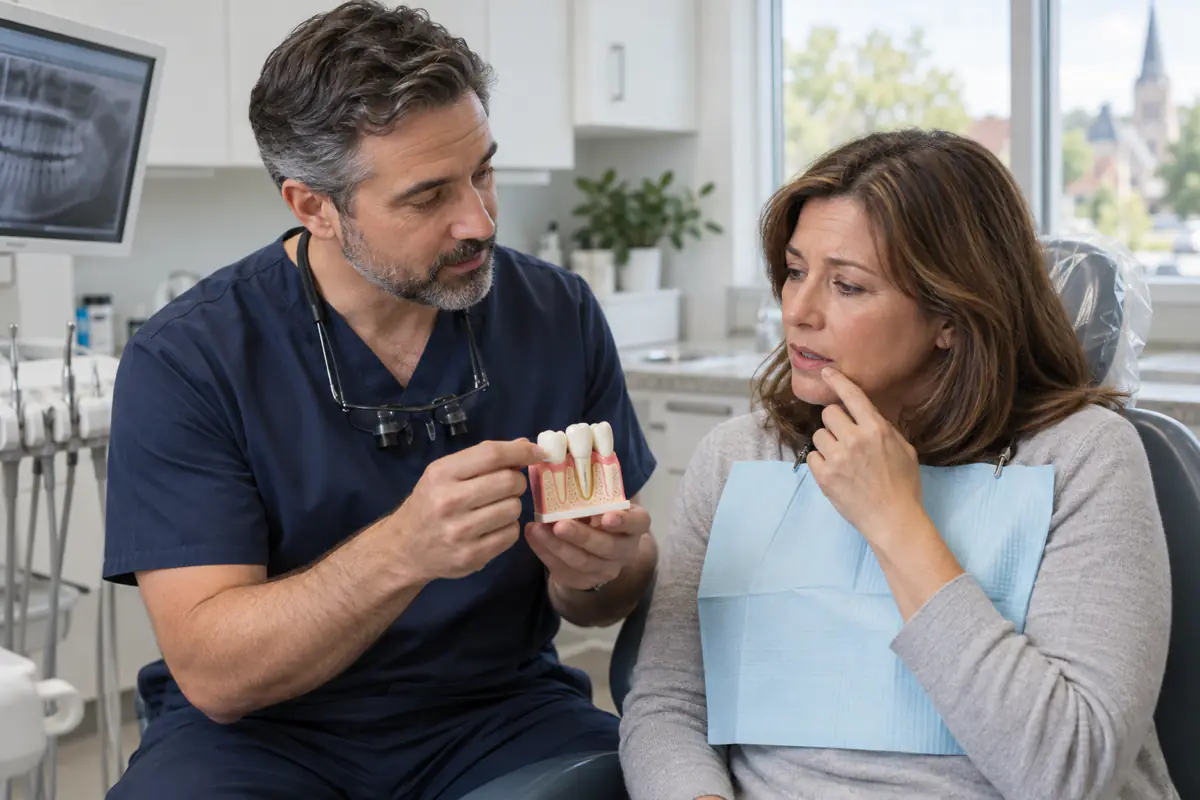
A permanent tooth should not suddenly move during eating or cleaning. If you notice a loose adult tooth in Simcoe, arrange a dental assessment promptly and avoid repeatedly testing it. Mobility can come from gum and bone loss, a recent impact, infection, a fracture or excessive forces. The chance of keeping the tooth depends on identifying the cause before more support is lost.
Loose does not always mean hopeless. Some injured teeth can be repositioned and stabilized, while inflammation-related mobility may improve after periodontal treatment. Other teeth are too fractured or have too little support to restore predictably. Only an examination and appropriate imaging can distinguish these situations.
How a tooth normally stays stable
A tooth is not fused directly to the jawbone. Its root is suspended in the socket by the periodontal ligament, a thin layer of fibres that cushions chewing forces. Gum tissue forms a protective seal, while bone surrounds and supports the root.
Very slight physiological movement exists even in healthy teeth, but most people cannot feel it. Noticeable side-to-side motion, a tooth that seems taller, or movement that develops suddenly is not normal.
The ligament can become inflamed after trauma or heavy biting. Periodontal disease can destroy ligament attachment and bone over time. A root fracture can divide the tooth itself. Each mechanism needs a different response.
Periodontal disease is a common cause
Plaque retained around teeth can trigger gingivitis. In susceptible people, inflammation progresses below the gumline and damages supporting attachment and bone. As support is lost, teeth may shift, flare, develop spaces or become mobile.
Other signs can include bleeding, recession, persistent bad breath, pus, tenderness and pain while chewing. However, periodontal disease may progress quietly, particularly in people who smoke.
The NIDCR gum-disease guide identifies loose teeth and painful chewing among signs of advanced disease. Smoking, diabetes, genetics, age and certain illnesses or medications can affect risk and response to treatment.
A blow or fall can loosen a tooth
Sports injuries, vehicle collisions and falls can stretch or tear the periodontal ligament without knocking the tooth out. A tooth may be tender, mobile, displaced or appear longer than its neighbours. Nearby teeth and the jaw can be injured even when they look intact.
After trauma, do not push or pull the tooth unless a dental professional gives immediate instructions. Avoid biting with it and seek urgent assessment. A dentist may reposition a displaced tooth and attach a flexible splint to neighbouring teeth while the ligament heals.
Head injury signs, loss of consciousness, vomiting, severe facial bleeding or suspected jaw fracture require emergency medical assessment. Dental treatment follows stabilization of the person.
Grinding and excessive bite force
Clenching and grinding can overload teeth and their supporting tissues. Signs may include flattened edges, chips, cracks, morning muscle fatigue and tenderness when chewing. A tooth that contacts earlier than the others after a new filling or crown can also feel sore or slightly mobile.
Heavy force alone does not explain every loose tooth and should not be diagnosed from wear marks alone. Periodontal support, fractures, infection and restoration fit must also be evaluated.
Treatment may involve adjusting a new restoration, managing inflammation and using a properly assessed night guard. An appliance protects selected teeth but does not rebuild bone lost to periodontal disease.
Infection around a root
Deep decay, a crack or trauma can damage the pulp inside a tooth. Infection may travel through the root and inflame surrounding bone. The tooth can feel raised, tender or mobile, often with throbbing, swelling or a gum bump.
Treatment may include root canal therapy when the tooth is restorable, or extraction when it is not. Antibiotics are not a stand-alone repair for an infected root and are used only when clinically indicated.
If swelling spreads, fever develops or you feel significantly unwell, call urgently. Trouble breathing or swallowing and swelling toward the eye or neck require emergency medical care.
Cracks and root fractures
A vertical root fracture can create a narrow deep periodontal defect, recurrent swelling and localized mobility. It may follow trauma or occur in a structurally weakened tooth. Fine cracks are not always visible on an ordinary X-ray.
A horizontal root fracture after impact has a different prognosis depending on its location, displacement and pulp response. Some teeth can heal with appropriate repositioning, splinting and monitoring.
The American Association of Endodontists stresses immediate examination after traumatic injuries because adjacent damage may be hidden. Do not assume that a loose tooth simply needs time.
Can orthodontic treatment make teeth feel loose?
Orthodontic force deliberately remodels bone and ligament so teeth can move. Mild mobility during active treatment may be expected, but significant movement, pain, swelling or a sudden change should be reported to the orthodontist.
Do not stop wearing prescribed elastics or adjust an appliance independently. The orthodontist will decide whether the force, gum health or another condition needs attention.
Excellent plaque control is important throughout treatment. Inflamed gums and periodontal breakdown are not a necessary part of orthodontics.
Other conditions that affect support
Several factors can contribute to mobility or complicate healing:
- diabetes, especially when poorly controlled;
- smoking and other tobacco exposure;
- severe dry mouth and root decay;
- osteoporosis and medicines that affect bone treatment decisions;
- immune suppression;
- biting on a hard object;
- poorly fitting removable appliances; and
- advanced decay below the gumline.
Osteoporosis does not mean every mobile tooth comes from weak jawbone. Dental causes still require direct examination. Share medical diagnoses and medicines so treatment planning is safe.
What to do right now
Until you are seen:
- Stop wiggling the tooth with your tongue or fingers.
- Chew on the other side and choose soft foods.
- Continue gentle cleaning with a soft brush.
- Do not tie, glue or splint the tooth yourself.
- Bring details of any injury and all medications.
- Call promptly and describe how much it moves, whether trauma occurred and whether swelling or fever is present.
If the tooth becomes completely avulsed, the first-aid steps change and time matters. Follow our knocked-out tooth guide and contact a dentist immediately.
How the dentist evaluates mobility
The dentist takes a history and compares movement with nearby teeth. They assess gum pockets, recession, bleeding, plaque, calculus, bite, sensitivity and restoration condition. Cold or electrical pulp tests may be used after trauma or when infection is suspected.
Dental X-rays show bone levels, root shape, infection and some fractures. Images taken from different angles or three-dimensional imaging may be indicated, but not every crack becomes visible.
The pattern matters. One suddenly mobile tooth after an impact suggests something different from gradual movement of several teeth with deep periodontal pockets.
Treatment for periodontal mobility
The first goal is to control inflammation and infection. Scaling and root planing may remove deposits below the gumline. Home cleaning, smoking cessation support and diabetes management contribute to the response. Advanced defects may require periodontal surgery or specialist referral.
Mobility can decrease as inflammation resolves, but lost bone does not automatically return. The remaining support, tooth shape, bite and ability to keep the site clean influence prognosis.
A splint may connect a mobile tooth to stable neighbours for comfort and function in selected cases. Splinting without treating active periodontal disease only masks the cause.
Treatment after trauma
A displaced permanent tooth may be gently repositioned and stabilized with a flexible splint. The type and duration depend on the injury and whether bone is fractured. Soft-tissue wounds, tetanus status and other facial injuries are also reviewed.
The pulp may recover, especially in a young tooth with incomplete root development, or it may lose vitality later. Follow-up examinations and X-rays track healing, root resorption and infection. Feeling normal after a week does not eliminate the need for monitoring.
Avoid contact sports and hard biting until the treating clinician gives clearance.
Root canal treatment or extraction
When mobility is related to infection from a damaged pulp, root canal treatment can remove diseased tissue from a restorable tooth. A crown or other restoration may be needed afterward to protect weakened structure.
Extraction may be recommended when a tooth is split, has a deep untreatable root fracture, lacks enough periodontal support or cannot be restored above the bone and gum. Ask what finding makes the prognosis poor and whether specialist review would change the options.
After removal, replacement with an implant, bridge or partial denture may be considered. Timing depends on healing, infection, bone, neighbouring teeth and overall goals.
Is splinting always helpful?
No. A splint is useful when it protects healing tissues or improves comfort, but it can trap plaque and transfer force to neighbouring teeth. The material, flexibility and duration must suit the diagnosis.
Long-term splinting may help selected periodontally compromised teeth function, provided disease is controlled and the device can be cleaned. It does not make a non-restorable root fracture heal.
Never use wire, adhesive or a sports mouthguard to improvise a splint at home.
Eating and cleaning around a loose tooth
Use the unaffected side and avoid crusty bread, nuts, raw hard vegetables and sticky candy until assessed. Do not bite directly into food with a loose front tooth.
Continue brushing gently because plaque increases inflammation. Your dental team may recommend a small interdental brush, floss threader or another tool around a professional splint. Follow their instructions so you do not pull on the material.
If cleaning causes persistent heavy bleeding or the splint detaches, contact the office rather than discontinuing care indefinitely.
Warning signs that need faster care
Call urgently for increasing movement, severe pain, gum or facial swelling, fever, pus, a bad taste, recent trauma or inability to close the teeth normally. A person receiving cancer treatment, taking immune-suppressing medicine or living with poorly controlled diabetes may need a lower threshold for assessment.
Seek emergency medical help for breathing or swallowing difficulty, rapidly spreading swelling, serious facial injury, loss of consciousness or uncontrolled bleeding.
Mobility without pain is still important. Periodontal disease and some root fractures can progress quietly.
Preventing future mobility
Brush with fluoride toothpaste, clean between teeth and attend examinations at the interval recommended for your periodontal risk. Do not smoke. Work with your medical team to manage diabetes and other health conditions.
Wear a properly fitted sports mouthguard and avoid chewing ice or using teeth as tools. If you clench or grind, ask for an assessment before buying an appliance.
Complete recommended follow-up after trauma, root canal treatment and periodontal therapy. Early changes on an X-ray or gum chart can be addressed before movement becomes obvious.
Assessment for a loose adult tooth near Simcoe
Port Dover Family Dentistry provides focused examinations for patients travelling from Simcoe and elsewhere in Norfolk County. We can assess mobility, obtain appropriate images, treat contributing dental conditions and coordinate periodontal or endodontic referral when needed.
Call 519-583-2929 and describe any injury, swelling or fever. For non-urgent care, request an appointment; online requests are confirmed only after our team responds.
Frequently asked questions
Can salt water tighten a loose tooth?
No rinse restores lost bone, repairs a fracture or reattaches a displaced tooth. A mild rinse may feel soothing, but diagnosis and cause-specific treatment are still necessary.
Does a loose tooth always need extraction?
No. Some teeth stabilize after trauma care, periodontal treatment or correction of an excessive bite. Extraction is considered when the tooth cannot be predictably restored or supported.
Can a night guard save a loose tooth?
A guard may reduce damaging grinding force in selected cases. It does not treat infection, repair a fracture or reverse advanced periodontal bone loss, so an examination must come first.
About the author
Port Dover Family Dentistry Team
Our team provides family-focused dental care in Port Dover, Ontario. We create practical oral-health education to help patients ask informed questions and feel more confident about care. This article is general information and does not replace an examination or personalized diagnosis.