
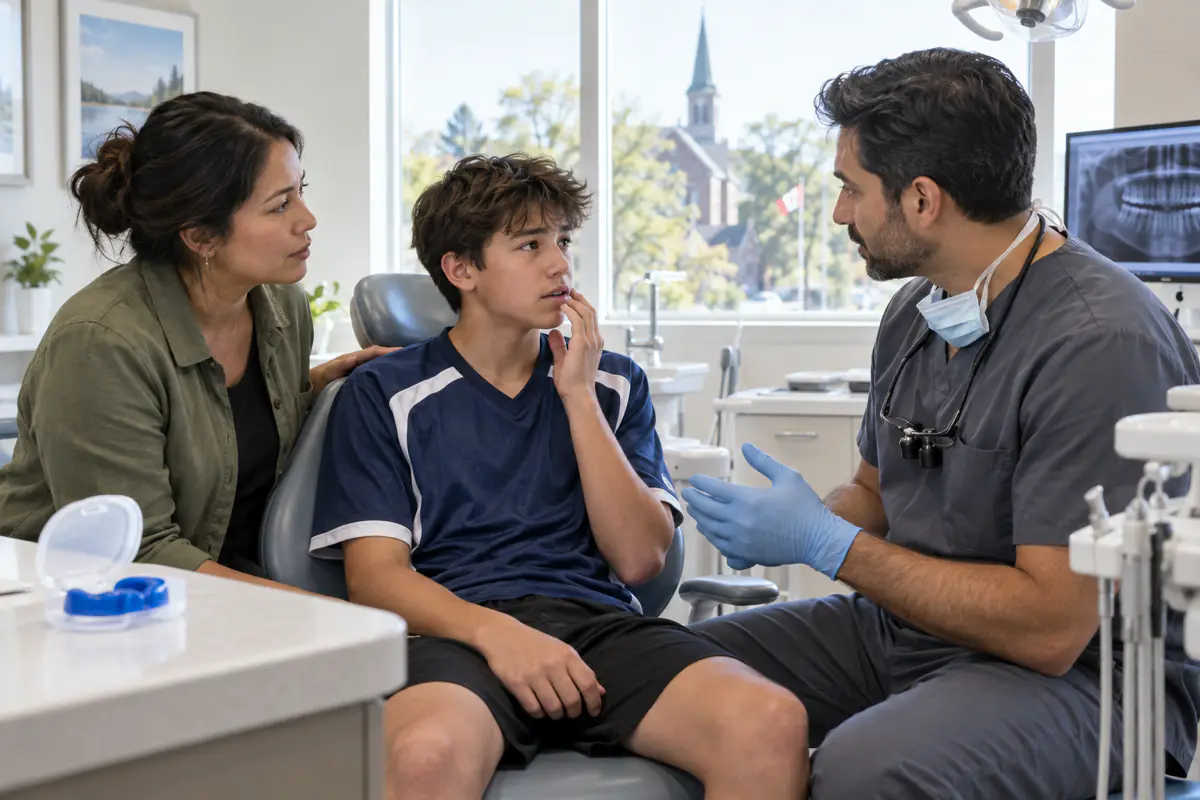
A knocked-out tooth in Simcoe is one of the few true time-critical dental emergencies. Dentists call the injury avulsion: the entire tooth leaves its socket after a fall, collision or direct blow. What happens in the first few minutes can influence whether a permanent tooth can be replanted successfully.
The first question is whether the missing tooth is permanent or primary. A permanent tooth may be replanted when the situation is safe. A baby tooth must not be put back because doing so can harm the permanent tooth developing underneath. If you are uncertain, call a dentist immediately and follow their instructions.
First check the person, not the tooth
Dental first aid comes after immediate threats to life and health. Following a hard impact, look for loss of consciousness, confusion, vomiting, unequal pupils, severe headache, neck pain, trouble breathing, heavy bleeding or suspected jaw fracture. Call emergency services when those signs are present.
Do not attempt to replant a tooth in someone who is unconscious, cannot cooperate or might inhale it. Control facial bleeding with gentle pressure using clean gauze. If the injury happened in traffic, during a major fall or with other serious trauma, medical assessment may take priority.
Once the person is stable, locate the tooth quickly. Check the mouth as well: a tooth that appears missing may have been pushed into the gum, displaced sideways or fractured rather than completely avulsed.
The essential steps for a permanent tooth
The current IADT avulsion guidance endorsed by the American Academy of Pediatric Dentistry emphasizes prompt, correct action. For a knocked-out permanent tooth:
- Find the tooth. Pick it up by the crown—the white part normally visible in the mouth.
- Do not touch the root. Cells on the root surface are important to healing and are easily damaged.
- If dirty, rinse briefly and gently. Use milk, saline or the injured person’s saliva. Do not scrub.
- Replant promptly when safe and feasible. Place the tooth back in its original orientation without force.
- Have the person hold it in place. Gentle biting on clean gauze or a cloth can stabilize it.
- If you cannot replant it, keep it moist. Place it in an appropriate storage medium, commonly cold milk, and go immediately for dental care.
Call the dental office while travelling so the team knows an avulsion has occurred. Do not wait for a routine opening in the schedule.
Never replant a baby tooth
Children lose primary teeth naturally, which can make identification confusing. Baby incisors are smaller and often have roots that look shortened because they resorb as the permanent successors approach. A knocked-out primary tooth should not be returned to the socket.
Replantation can injure the developing adult tooth or cause other complications. The child still needs prompt evaluation because the lip, gum, jaw and nearby teeth may be injured. The dentist will also check whether the entire tooth is accounted for.
If you do not know whether the tooth is primary or permanent, do not guess under pressure. Contact a dentist immediately, state the child’s age and which tooth is missing, and follow professional direction.
Why handling the root matters
The root is covered by a delicate layer called the periodontal ligament. Living cells in this layer help the tooth reattach to the socket. Touching, scraping, drying or disinfecting the root can damage those cells.
Hold only the smooth crown. Do not scrape off tissue, brush the root, wrap the tooth in a tissue, or clean it with soap, alcohol, peroxide or household disinfectant. A tooth that looks dirty does not need aggressive cleaning at the accident scene.
If the crown has a fracture, collect any additional fragments and transport them too. The priority is still immediate care for the person and moist storage of the avulsed tooth.
How to rinse a dirty tooth
Use a gentle stream of cold milk, sterile saline or the person’s saliva for a few seconds. The purpose is to remove loose debris without disturbing the root surface. Hold the crown throughout.
Do not scrub with a toothbrush or cloth. Do not soak the tooth in bleach or mouthwash. Tap water is not a good long-term storage medium, although a brief gentle rinse may be preferable to vigorous cleaning when no recommended liquid is available. Ask the emergency dental team for real-time instructions whenever possible.
Once rinsed, immediately replant it if appropriate or transfer it to the storage medium. Leaving it on a counter while arranging transportation allows damaging dehydration to continue.
Replanting at the scene
Immediate replantation of a permanent tooth is generally the best option when the person is conscious and cooperative and the tooth can be positioned safely. Face the smooth outer surface toward the lip, guide the root into the socket with gentle pressure, and have the person bite softly on gauze.
Never force a tooth into place. A socket or jaw fracture, debris, clot or incorrect orientation can make positioning difficult. If it does not slide back easily, stop, place it in the recommended liquid and seek care.
Replantation at the scene does not finish treatment. The tooth must be checked, positioned and stabilized by a dentist, and other injuries require assessment.
Best ways to transport the tooth
If replantation is not possible, the tooth must stay moist. Commercial tooth-preservation solution, when immediately available, is designed for this situation. Cold milk is a practical and widely available alternative. Saline or saliva held in a clean container may be used according to professional guidance.
Do not store the tooth dry. Do not wrap it in gauze or paper towel, and do not place it loose in a pocket. Avoid having a young child hold it inside the mouth because of swallowing or aspiration risk. Plain water is less suitable for extended storage because it can damage root-surface cells.
Bring the container directly to the dental office. The shorter the dry time, the better the biological conditions for healing.
Time is more important than distance
People sometimes spend valuable time searching for the “perfect” specialist or cleaning the tooth repeatedly. The immediate goal is correct first aid and access to a dental clinician who can assess, replant or stabilize the tooth and coordinate follow-up.
Call the nearest available dental office and clearly say, “A permanent tooth has been knocked out.” Tell them when it happened, how the tooth is stored, the person’s age and whether there was loss of consciousness. If that office cannot provide care, ask where to go without delay.
Even when the tooth was dry for a prolonged period, bring it. The dentist must consider the full situation rather than deciding by phone that nothing can be done.
What the dentist does
At the emergency visit, the dentist reviews the injury, medical history, tetanus status and storage details. Examination and X-rays help identify socket fracture, root damage, intrusion of another tooth, foreign material and jaw injury.
If the tooth is replanted, its position is confirmed and it is usually attached to nearby teeth with a flexible splint for a defined period. The dentist cleans and treats soft-tissue wounds and provides individualized instructions. Antibiotics may be considered based on the injury and patient; they are not a substitute for replantation, stabilization or follow-up.
Root canal timing depends on root development and other factors. A mature permanent tooth and an immature tooth are managed differently, which is why follow-up with a dentist or endodontist is essential.
Healing is a process, not a single visit
A replanted tooth needs scheduled clinical and X-ray monitoring. The dentist checks pulp status, root changes, gum healing, bite and mobility. Complications may include infection, root resorption, ankylosis—fusion of the root to bone—or eventual tooth loss.
These possibilities do not mean replantation was pointless. Preserving a tooth, even for a limited period, can support appearance, function and bone while a child grows or while a long-term plan is developed. The likely outlook is individual and may change over time.
Attend every follow-up even when the tooth feels normal. Some root and bone changes are painless at first and are found only through comparison over time.
Eating and cleaning after replantation
Follow the treating dentist’s exact instructions. A soft diet is commonly recommended during early healing, with avoidance of biting directly on the injured tooth. Keep the area clean using a soft toothbrush and any prescribed rinse.
Do not wiggle the tooth to “check” whether it is firm. Do not adjust or remove the splint at home. Contact the office if the splint loosens, the bite changes, swelling increases, fever develops or pain is not controlled.
Sports should pause until the treating clinician advises it is safe to return. A second impact during healing can compromise both the injured tooth and neighbouring teeth.
Other dental injuries can look similar
A displaced tooth may be pushed inward, outward or sideways while remaining partly in the socket. A crown can fracture while the root stays behind. A jaw injury may make several teeth move together. These problems require urgent assessment but have different first-aid steps.
Do not pull a displaced tooth into position without dental advice. Do not remove a loose fragment that is still attached to gum tissue. If a broken tooth has a red or pink centre, the pulp may be exposed and prompt treatment is important.
Our guide to a broken or chipped tooth explains additional injury patterns, but a call to a dentist should come before online reading when trauma is fresh.
Preventing avulsion during sports
Contact and collision sports are common settings for dental trauma. A properly fitted mouthguard cushions impact and separates soft tissues from teeth. Custom-fitted guards generally offer secure fit and can be designed around braces or changing dentition.
Wear the guard during practice as well as competition. Replace it when torn, distorted, too loose or no longer compatible with growth or orthodontic movement. Rinse after use, clean it according to instructions and store it in a ventilated case away from heat.
Helmets and face shields add protection in sports that call for them, but they do not make a mouthguard unnecessary. Read our sports mouthguard guide for fitting and care considerations.
Prepare coaches, teachers and caregivers
An emergency plan works best before an accident. Families can save their dentist’s number, keep a tooth-preservation kit with team supplies and teach adults the crown-only handling rule. Coaches should know that primary teeth are not replanted and that a concussion assessment may be needed.
A simple action card can say: check the person, identify permanent versus baby tooth, hold the crown, rinse gently, replant if safe or keep in milk, and obtain immediate dental care. It should also identify who calls the parent and who manages the rest of the group.
Preparation reduces hesitation without replacing professional instructions.
Emergency dental help near Simcoe
If someone has a knocked-out tooth in Simcoe, call for dental help immediately. Port Dover Family Dentistry serves families from Simcoe and across Norfolk County and can advise on the next appropriate step based on the injury and available care.
Call 519-583-2929 and state that a tooth was completely knocked out. If there are signs of head or neck injury, breathing difficulty, uncontrolled bleeding or another medical emergency, call 911 or go to the appropriate emergency department.
For non-emergency planning, you can request an appointment. Online requests are not monitored as emergency calls and are not confirmed until our team responds.
Frequently asked questions
Can I clean the tooth with soap or peroxide?
No. Chemical disinfectants and scrubbing can damage the root-surface cells needed for healing. Hold the crown and use only a brief gentle rinse with an appropriate liquid.
What if the tooth has been dry for an hour?
Do not discard it. Place it in an appropriate storage liquid and obtain urgent dental care. Longer dry time changes the prognosis and treatment considerations, but a dentist should assess the individual injury.
Does the person need a tetanus booster?
Tetanus status is part of the injury review, especially when the tooth or wound contacted soil. The dental or medical clinician will advise whether immunization follow-up is needed based on the wound and vaccination history.
About the author
Port Dover Family Dentistry Team
Our team provides family-focused dental care in Port Dover, Ontario. We create practical oral-health education to help patients ask informed questions and feel more confident about care. This article is general information and does not replace an examination or personalized diagnosis.