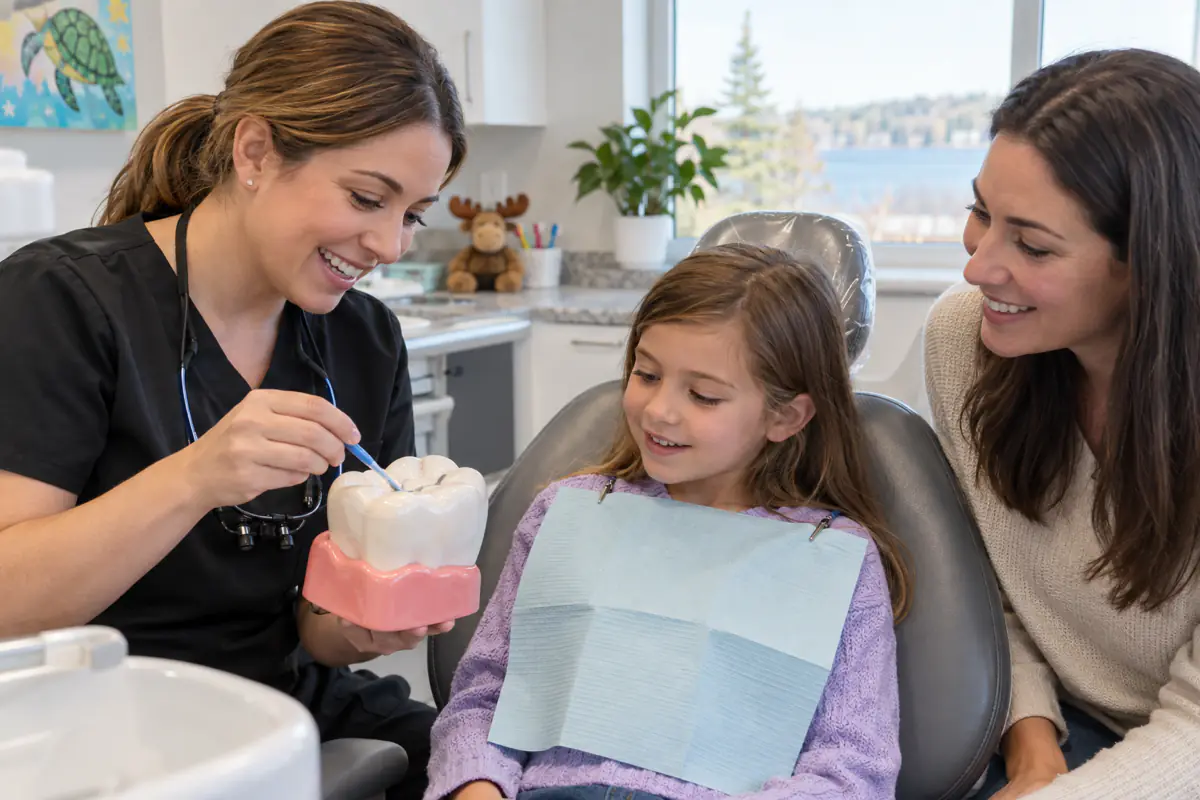
Back teeth are designed for chewing, but their deep pits and grooves can trap plaque where toothbrush bristles do not reach well. Dental sealants in Simcoe provide a thin protective coating over these vulnerable chewing surfaces, most often on children’s permanent molars.
Sealants are preventive, not a substitute for brushing or a repair for every cavity. When used for the right tooth at the right time, they create a smoother barrier that helps keep food and bacteria out of narrow grooves. Understanding how they work makes the decision easier for parents and children.
What a dental sealant is
A sealant is a flowable resin or similar dental material applied to the pits and fissures of a tooth. It bonds to the enamel and hardens into a thin covering. Most are tooth-coloured, clear or slightly tinted, so they are not obvious during a normal smile.
The material does not wrap around the whole tooth. It protects the grooved biting surface where decay often begins. Smooth outer and inner surfaces, contact areas between teeth and the gumline still require normal cleaning and fluoride exposure.
The National Institute of Dental and Craniofacial Research describes sealants as thin coatings that fill the pits and grooves on children’s back teeth, preventing food and germs from remaining where bristles cannot easily remove them.
Why molars are vulnerable
Permanent molars often have valleys and fissures that are narrower than a toothbrush bristle. Their anatomy varies: one child may have shallow, self-cleansing grooves, while another has deep stained fissures that retain plaque.
Newly erupted enamel is also still maturing through contact with saliva and fluoride. Children are learning consistent brushing, and a back molar that has only partly emerged can be especially hard to reach. Frequent snacks or sweet drinks add repeated acid attacks.
Sealants reduce one important route to decay while skills and enamel mature. They are most useful when the chewing surface is sound or has only a very early, non-cavitated change that can be appropriately sealed and monitored.
When permanent molars arrive
First permanent molars typically erupt near age six behind the primary teeth. Because no baby tooth falls out to make room, families sometimes mistake them for temporary teeth. These “six-year molars” need lifelong protection.
Second permanent molars often erupt around age twelve. Timing varies, so age alone does not determine readiness. Enough tooth must be visible to isolate it from saliva during placement.
Premolars or primary molars may also be considered for sealants when groove anatomy and cavity risk justify it. Sealants are not only for one exact age and can benefit selected teenagers and adults with deep, decay-free fissures.
Who benefits most?
The dentist considers the tooth and the person. Factors that may support sealant placement include:
- deep pits and grooves;
- previous cavities or fillings;
- early enamel changes on chewing surfaces;
- limited fluoride exposure;
- frequent sugar or refined-carbohydrate intake;
- dry mouth or medication affecting saliva;
- orthodontic or developmental challenges that complicate cleaning;
- a sibling or family pattern of high decay; and
- difficulty maintaining plaque control because of age, dexterity or disability.
A child with low risk and shallow, easily cleaned grooves may have less need. The decision is individualized rather than automatically sealing every tooth.
What happens at the appointment
Sealant placement usually does not require drilling or freezing. The steps are straightforward:
- The tooth is examined and cleaned.
- It is isolated and kept dry with cotton, suction or another method.
- A conditioning liquid prepares the enamel surface.
- The tooth is rinsed and dried according to the material instructions.
- Sealant flows into the grooves.
- A curing light hardens light-activated material.
- The dentist checks coverage and the way the teeth bite together.
The appointment is painless for most children, but keeping a newly erupted tooth dry requires cooperation. The team can explain each step and provide breaks. If isolation is not possible, the dentist may wait or consider a moisture-tolerant interim material.
Why dryness is important
Saliva contamination can interfere with bonding. A sealant that never properly adheres may detach early. Careful isolation and inspection therefore matter more than applying material quickly.
Partly erupted molars have a flap of gum over part of the surface, making isolation challenging. Waiting until more tooth emerges may improve retention, but a very high-risk surface may need another short-term preventive approach. The dentist weighs risk against technical conditions.
Can decay be sealed underneath?
A tooth with a clear open cavity generally needs restorative treatment rather than a routine sealant. Very early, non-cavitated lesions can sometimes be sealed because cutting off the bacterial nutrient supply may arrest progression, provided the diagnosis is appropriate and the seal remains intact.
This decision requires clinical judgment. The tooth may be inspected visually, gently examined and sometimes X-rayed when decay between teeth or beneath the surface is a concern. Parents should ask whether the surface is sound, early-stage or cavitated and how it will be monitored.
A dark groove is not automatically decay. Stain can remain in sound enamel, while an apparently pale groove may hide demineralization.
How long sealants last
Sealants can remain protective for years, but no material is permanent. Chewing forces, grinding, isolation quality and tooth anatomy influence retention. A sealant may wear gradually, lose a small edge or come off.
At checkups, the dental team examines or gently tests the coating. A worn area can often be cleaned and repaired without removing the whole sealant. A lost sealant does not mean the tooth was harmed; it means the surface should be reassessed and recoated if still appropriate.
Parents do not always see loss at home. Keep recall visits rather than waiting for the material to look broken.
Eating and care after placement
Light-cured sealants are hard when the appointment ends, so children can usually eat normally unless the dental team gives different instructions. The bite may feel slightly different at first. A significant high spot or discomfort that persists should be checked.
Brush the sealed teeth twice daily with fluoride toothpaste. Clean between them once contacts close. Avoid using molars to crack hard objects or chew ice, which can damage enamel and dental materials.
No special “sealant diet” is required, but limiting how often teeth encounter sugar benefits every surface.
Sealants and fluoride do different jobs
Sealants create a physical barrier over specific pits and fissures. Fluoride strengthens exposed enamel and supports remineralization across many tooth surfaces. They complement rather than replace each other.
A child with sealants still needs fluoride toothpaste. Professional fluoride varnish may be recommended according to cavity risk. Drinking fluoridated water, where available, provides repeated low-level exposure.
Our guide to choosing a toothbrush and toothpaste in Simcoe explains fluoride, brush size and age-appropriate supervision.
Home care by age
Young children need an adult to brush thoroughly, even when they want to do it independently. A small soft brush helps reach behind the last tooth. Lift the cheek gently and angle the bristles onto the chewing grooves and gumline.
As children become more independent, parents should continue checking the result. Disclosing tablets used under supervision can reveal missed plaque. Orthodontic appliances and crowded teeth may require specialized brushes or flossing tools.
Sealants do not protect against cavities between teeth. Once adjacent teeth touch, daily interdental cleaning becomes important.
Food frequency and school routines
Each sugary or starchy snack gives plaque bacteria another opportunity to make acid. Sticky foods can remain in grooves, but even liquids reach between teeth. Repeated juice, sweetened coffee, sports drinks or flavoured milk throughout the day can create more exposure than one dessert with a meal.
Pack water as the routine drink and include cheese, vegetables, plain yogurt or other lower-sugar choices when suitable. Our tooth-friendly school lunch guide offers practical ideas without treating food as morally good or bad.
Children who use inhalers or medicines that dry the mouth may need a tailored prevention plan.
Safety and material questions
Dental sealants have a long history of use. Parents sometimes ask about bisphenol A, or BPA. Some resin materials can produce extremely small, short-lived exposures to related compounds, but professional organizations and public health agencies continue to support sealants because the cavity-prevention benefit outweighs the known risk when materials are properly used.
The clinician can rinse and wipe the surface after curing according to product guidance. If your child has a documented material allergy, share it before treatment. Ask which material is planned rather than relying on a general social-media claim about every sealant product.
Glass ionomer and resin-based materials have different handling, fluoride release and retention characteristics. The best choice depends on eruption, moisture control and clinical goal.
Sealants for children with special healthcare needs
Children who find brushing difficult because of motor, sensory or developmental factors may gain particular benefit from preventive barriers. Appointment pacing, visual schedules, desensitization visits and familiar supports can make placement easier.
Some children cannot tolerate a long dry-isolation period. Discuss what has worked in medical or dental settings. A shorter appointment, caregiver positioning or alternative material may be considered. Prevention should be individualized rather than withheld simply because cooperation differs.
When a tooth needs more than a sealant
Pain, a visible hole, broken enamel or an X-ray showing decay into dentin may indicate a filling or another restoration. A sealant cannot rebuild missing structure. Deep decay near the pulp needs careful assessment.
Call for an examination if a child reports toothache, pain on biting, lingering cold sensitivity or nighttime pain. Swelling, fever or a gum bump requires prompt dental care. See child toothache in Simcoe for urgent warning signs.
Questions parents can ask
At the checkup, ask:
- Which teeth are fully erupted and suitable?
- How deep are the grooves?
- What is my child’s overall cavity risk?
- Is any early decay present?
- Which material will be used and why?
- How will retention be checked?
- Does insurance cover the recommended teeth?
Coverage rules vary and should not replace a clinical discussion. Request an estimate if cost is a concern.
Ask about sealants near Simcoe
Port Dover Family Dentistry welcomes families from Simcoe and throughout Norfolk County. We can assess erupting molars, review cavity risk and explain how sealants, fluoride, diet and home care work together.
Call 519-583-2929 or request an appointment for a child’s preventive visit. If permanent molars have recently appeared, mention that when booking so the team can evaluate whether the timing is right for sealants.
About the author
Port Dover Family Dentistry Team
Our team provides family-focused dental care in Port Dover, Ontario. We create practical oral-health education to help patients ask informed questions and feel more confident about care. This article is general information and does not replace an examination or personalized diagnosis.