Searching for dental implants in Norfolk County often begins with a very practical problem: a tooth is gone, chewing feels different, and you want to know whether a fixed replacement is realistic. An implant can replace the root of a missing tooth and support a crown, bridge or denture. It can be an excellent option, but it is not simply a new tooth placed in one visit.
Good implant care starts with diagnosis. The condition of the gums, available bone, neighbouring teeth, bite, medical health and reason the tooth was lost all affect the plan. Whether you live in Port Dover, Simcoe, Waterford, Delhi or elsewhere in Norfolk County, a useful consultation should help you compare all reasonable choices—not assume an implant is automatically the answer.
What is a dental implant?
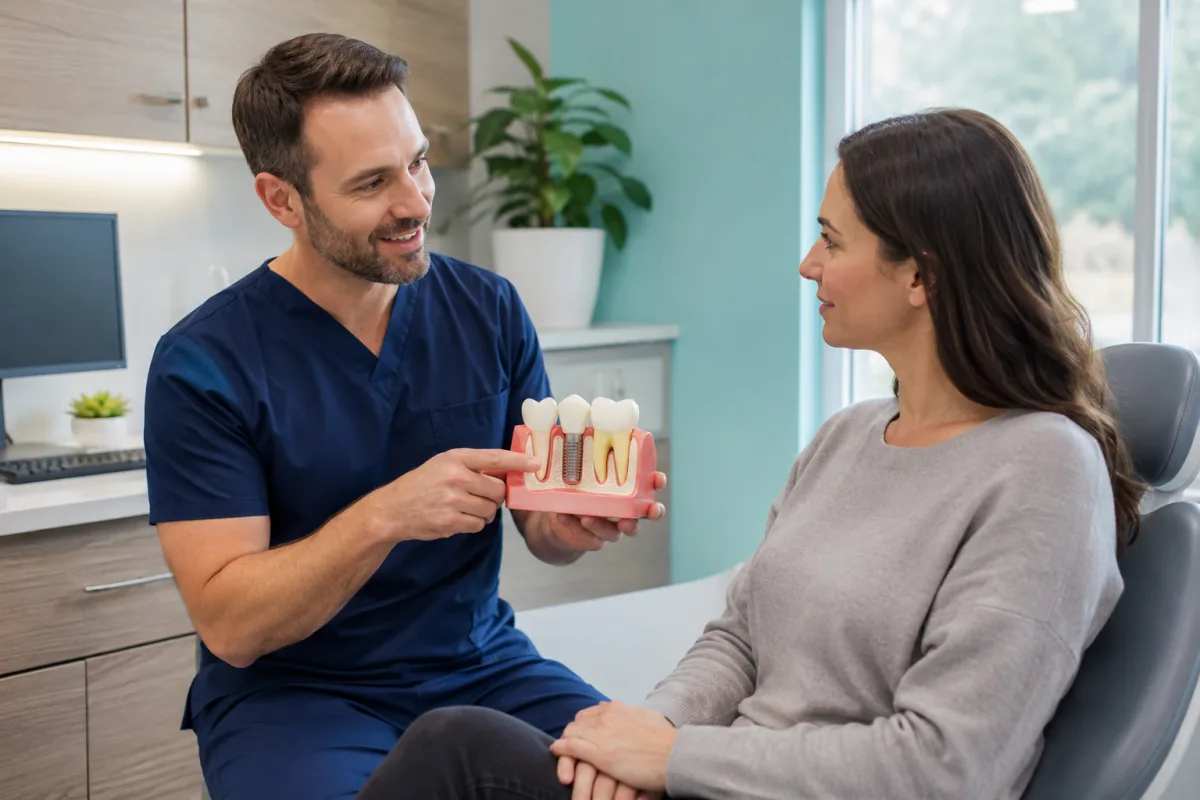
A dental implant is a small biocompatible post, usually made of titanium, placed in the jawbone. During healing, bone forms a close connection with its surface in a process called osseointegration. An abutment connects the implant to the visible restoration.
The word “implant” is often used for the whole replacement, but there are three parts:
- Implant: the post within the jawbone.
- Abutment: the connector above the implant.
- Restoration: the crown, bridge or denture that provides appearance and function.
Each part has a different job and may be placed at a different appointment. The crown can wear or chip even when the implant remains integrated, just as a restoration on a natural tooth can require maintenance.
Ways implants can replace missing teeth
One implant can usually support one crown when a single tooth is missing. If several adjacent teeth are absent, two or more implants may support a fixed bridge; one implant is not necessarily required for every missing tooth. When most or all teeth are missing, implants can help retain a removable denture or support a fixed full-arch restoration.
These designs differ substantially in surgery, cleaning, repair, cost and the amount of space needed. “All-on-four” and similar terms describe particular concepts, not a universal solution. Full-arch treatment requires especially careful planning because it changes an entire bite.
An implant-supported restoration is also different from a traditional dental bridge, which uses neighbouring teeth for support, and from a removable denture. A person may reasonably choose any of these options after considering health, predictability, convenience, finances and personal preference.
Why replace a missing tooth?
Not every space must be restored. A dentist considers location, chewing function, appearance, speech, opposing teeth and the stability of the remaining bite. Leaving a gap can sometimes allow neighbouring or opposing teeth to drift, but movement varies.
For many people, replacement can:
- restore a useful chewing surface;
- prevent a visible gap from affecting confidence;
- support speech in certain locations;
- avoid preparing adjacent teeth for a conventional bridge; and
- improve the stability of a loose denture.
An implant transfers force to the surrounding bone, which can help maintain bone at that site. It does not freeze the jaw in time, prevent all age-related change or protect other teeth from gum disease and decay.
Who may be a candidate?
Many healthy adults with one or more missing teeth can be assessed for implants. Age by itself is rarely the deciding factor; growth must be complete in younger patients, while older adults are evaluated according to health and healing rather than a birthday.
Favourable conditions include healthy gums, adequate bone, manageable bite forces, good plaque control and the ability to attend follow-up. Potential challenges include:
- active or previously uncontrolled gum disease;
- smoking or vaping;
- poorly controlled diabetes;
- substantial grinding or clenching;
- limited bone or space;
- certain medicines or conditions affecting bone and healing;
- previous radiation in the jaw area; and
- difficulty cleaning or attending maintenance.
These factors do not all create an automatic “no.” They change risk and may require medical coordination, preliminary care, specialist involvement or another solution. Never stop a prescribed medicine to pursue dental treatment without speaking with the prescriber.
The implant assessment
The first visit is about the whole mouth, not only the gap. Your dentist reviews when and why the tooth was lost, symptoms, expectations, medical conditions, medications, tobacco use and prior dental experiences. The examination assesses decay, gum health, bite, available space, smile line and the condition of possible alternative support teeth.
Imaging is chosen for the question being answered. Regular dental radiographs can show neighbouring roots and general bone levels. Three-dimensional cone-beam imaging may be recommended to assess bone dimensions and nearby structures such as the maxillary sinus or lower-jaw nerve. A scan is useful when it changes planning; it is not a substitute for examination.
Digital or physical models may help determine the future tooth position before surgery. Planning from the final crown backward is important: the implant needs to emerge where the restoration can look natural, manage force and be cleaned.
Bone grafting and site preparation
Bone naturally remodels after a tooth is removed, and the ridge often becomes narrower. If the remaining shape cannot support an implant in a suitable position, grafting may be discussed. Graft material can help preserve a socket at extraction or rebuild a healed site. Upper back teeth may sometimes require sinus augmentation because the sinus occupies space above the jaw.
A graft adds healing time, cost and its own risks. It also has limits; it does not guarantee an implant. Some sites can receive an implant and graft together, while others need staged healing. In selected cases, a narrower or shorter implant or a non-implant restoration may be more appropriate.
If the failing tooth is still present, ask whether it can predictably be saved. Root canal treatment and a suitable restoration may retain a natural tooth in some situations. Extraction and implant placement are irreversible, so prognosis deserves a clear discussion.
What happens during placement?
Local anaesthetic is used to numb the area. The clinician prepares a precise channel in the bone, places the implant and closes or shapes the gum according to the technique. The implant may remain covered during healing or have a small healing component visible.
Some implants can support a temporary tooth immediately, but “same-day teeth” does not mean healing is finished. Immediate loading depends on initial stability, bone quality, bite and restoration design. A temporary replacement must be protected while integration occurs.
After surgery, tenderness, minor swelling and bruising are possible. Follow the individualized instructions for cleaning, food, activity and medication. Contact the office for worsening pain after initial improvement, increasing swelling, fever, persistent bleeding, numbness that does not resolve as expected or a loose component.
Healing and the final restoration
Osseointegration commonly takes weeks to months. Timelines vary by site, bone, grafting, health and loading. During this period, appointments may check the tissue and stability. Avoid testing or wiggling a healing component.
Once integration is confirmed, the restorative phase begins. A scan or impression records the implant position and surrounding teeth. The laboratory creates the abutment and crown, and the dentist checks fit, contacts, appearance and bite. The restoration may be secured with a screw or dental cement; each method has advantages and possible complications.
The finished tooth should be cleansable. Ask for a demonstration because the ideal tool depends on whether you have a single crown, bridge or denture.
Benefits and limitations
Implants can feel stable, preserve adjacent tooth structure and provide attractive results. High success rates described in research are encouraging, but success is not the same as permanence. Outcomes depend on the person, site, restoration and length of follow-up.
Possible complications include failure to integrate, infection, nerve or sinus injury, gum recession, food trapping, loosening, ceramic fracture and bone loss around the implant. Some problems occur early; others develop years later. An implant can also be healthy while its crown needs repair.
Peri-implant mucositis is inflammation limited to the soft tissue and may cause redness or bleeding. Peri-implantitis includes progressive bone loss and is more difficult to treat. Previous periodontitis, smoking and poor plaque control increase concern. Report bleeding, swelling, pus, bad taste, movement or persistent discomfort rather than waiting for a routine visit.
Daily care for a dental implant
An implant cannot get a cavity, but the tissue around it can become diseased. Brush twice daily with fluoride toothpaste to protect all remaining natural teeth. Clean the sides of the implant restoration every day with floss, an interdental brush, a water flosser or a threader, depending on its shape.
The right brush should contact the area without traumatizing the tissue. Metal instruments or abrasive home products can scratch some components. Your hygienist can choose tools and demonstrate access under an implant bridge.
Professional visits monitor plaque, bleeding, pocket changes, bite, screw stability and radiographic bone levels when indicated. Maintenance frequency is based on risk rather than a universal six-month rule. Read our guide to gum disease prevention because healthy periodontal habits also support implants.
Smoking, diabetes and grinding
Smoking is associated with poorer healing and more implant complications. Stopping before treatment and remaining tobacco-free improves the oral environment, although an exact risk cannot be promised.
Diabetes does not necessarily prevent implant treatment. Control matters. Share recent health information and coordinate with your physician when requested. Do not skip meals or change medication around surgery without professional direction.
Grinding can overload crowns, screws and supporting bone. Signs include tooth wear, broken restorations and muscle fatigue, but not every grinder knows they do it. Bite design and a protective appliance may be considered. A guard protects surfaces; it cannot guarantee that biological or mechanical complications will not occur.
Cost and insurance questions
The cost of dental implants in Norfolk County depends on the number of sites, imaging, extraction, grafting, sedation needs, implant components, laboratory restoration and specialist care. A low advertised price may represent only one stage. Request a written estimate showing what is included.
Ask whether the quote covers:
- consultation and imaging;
- extraction or grafting;
- implant placement;
- abutment and final restoration;
- temporary tooth options;
- follow-up and adjustments; and
- management if integration does not occur.
Dental benefit plans vary and may cover one stage while excluding another. Pre-determination can clarify expected reimbursement, but it is not a guarantee of payment. Choose treatment based on informed clinical and personal priorities, not only on an annual benefit deadline.
Questions worth bringing to a consultation
- Can the existing tooth be predictably saved?
- What are my implant, bridge, denture and no-treatment options?
- Is there enough bone and gum tissue?
- Would grafting or specialist care be needed?
- What factors raise my risk?
- What will I wear while the site heals?
- How long is the expected sequence?
- How will I clean the final restoration?
- What is included in the estimate?
- What maintenance will be needed long term?
Dental implant consultations near Port Dover
Port Dover Family Dentistry assesses missing teeth and explains whether dental implants in Port Dover, a bridge, a denture or another approach fits the clinical picture. Patients visit us from Port Dover and communities across Norfolk County, and referral is coordinated when a case needs additional expertise.
Call 519-583-2929 or request an appointment to begin with an examination. A thoughtful plan should leave you understanding both the opportunity and the responsibility of implant treatment.
Frequently asked questions
Is dental implant surgery painful?
Local anaesthetic is used during placement. Temporary soreness and swelling can occur afterward and are usually managed with the instructions provided. Severe or increasing pain needs a call to the treating office.
Can a smoker get a dental implant?
Sometimes, but smoking increases healing and long-term complication risks. The clinician will discuss cessation, individual risk and whether another replacement may be more predictable.
How long do implants last?
Implants are intended for long-term use, but no lifetime can be guaranteed. Health, hygiene, smoking, bite forces and maintenance all matter, and the attached crown may need repair or replacement before the implant itself.
About the author
Port Dover Family Dentistry Team
Our team provides family-focused dental care in Port Dover, Ontario. We create practical oral-health education to help patients ask informed questions and feel more confident about care. This article is general information and does not replace an examination or personalized diagnosis.