The choice of a dental implant vs bridge in Port Dover is not a contest with one universal winner. Both can replace a missing tooth with a fixed restoration. They differ in how they are supported, how long treatment takes, what happens to neighbouring teeth and which health factors affect the outcome.
The best comparison starts with the whole mouth, not an online list of average lifespans. The condition of the adjacent teeth, available bone, gum health, bite, medical history, priorities and budget all shape a responsible recommendation.
What is a conventional dental bridge?
A conventional fixed bridge uses teeth on either side of a gap as supports. Those teeth are prepared for crowns, and an artificial tooth called a pontic is connected between them. The completed bridge is cemented in place and is not removed for daily cleaning.
The American Dental Association’s MouthHealthy bridge guidance explains that bridges can restore appearance and function but require healthy supporting teeth and careful cleaning beneath the replacement tooth. Other bridge designs exist, including cantilever and resin-bonded bridges, but they have different indications and are not interchangeable.
A bridge can be especially reasonable when adjacent teeth already have large fillings, fractures or crowns and would benefit from new coverage. Preparing untouched healthy teeth solely to support a bridge is a larger tradeoff.
What is a single-tooth dental implant?
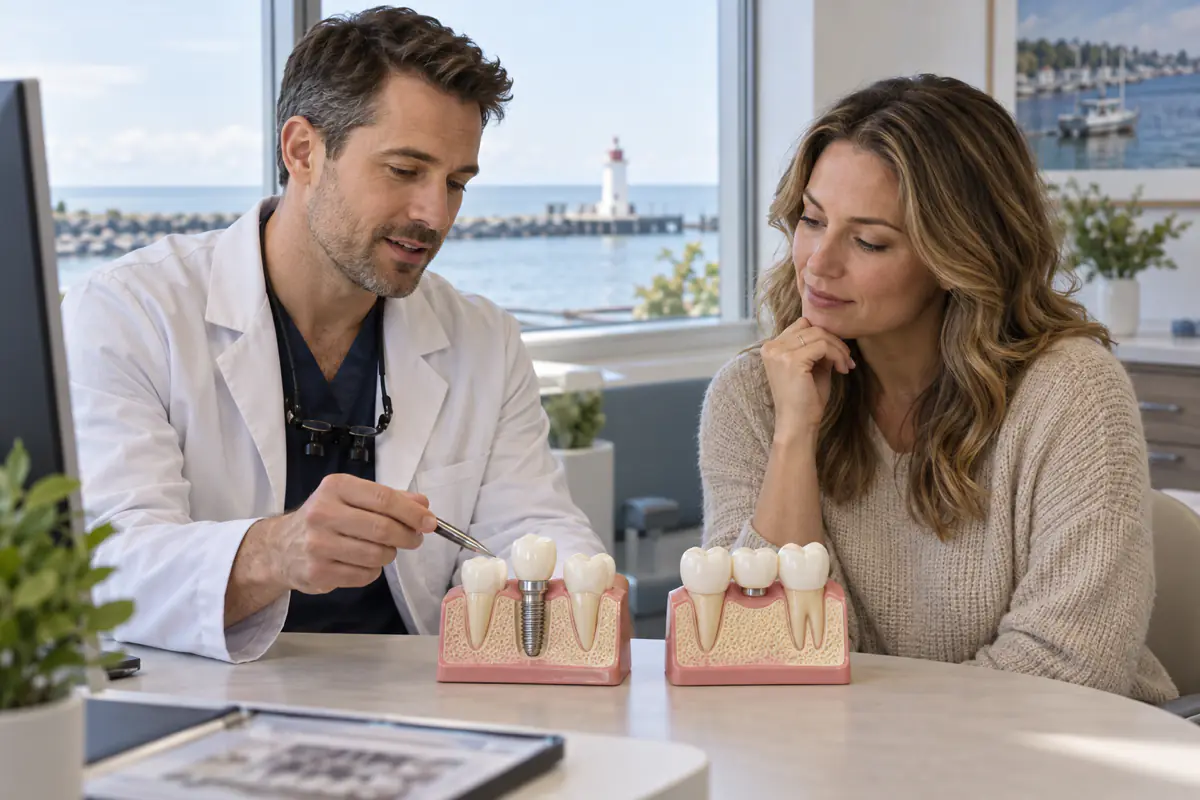
A dental implant is a biocompatible post placed in jawbone. After it becomes stable with the bone, a connector called an abutment supports a crown. Unlike a conventional bridge, the restoration does not rely on crowning the adjacent teeth.
The ADA’s overview of dental implants notes that adequate bone and healthy gums are important and that implant treatment requires meticulous oral hygiene and regular dental visits. An implant is a replacement for a missing root; the visible crown is a separate component and may need maintenance or replacement over time.
Implants cannot develop tooth decay, but the tissues around them can become inflamed and lose bone. “Not a natural tooth” does not mean maintenance-free.
Preserve a natural tooth when possible
Before comparing replacements, confirm that the tooth truly cannot be saved. Root canal treatment, periodontal care, a crown or another restoration may preserve a restorable tooth. Extraction is irreversible, and neither an implant nor a bridge perfectly reproduces a natural tooth.
The American Association of Endodontists encourages patients to consider treatment that retains a natural tooth before extraction when it has a predictable prognosis. A tooth with a vertical root fracture, severe structural loss or inadequate support may still be unrestorable. The decision depends on clinical evidence, not a blanket rule.
Effect on neighbouring teeth
An implant’s major advantage is independence. Adjacent teeth usually do not need to be reduced for crowns. This can preserve enamel when those teeth are healthy and minimally restored.
A conventional bridge requires significant reshaping of support teeth. Those teeth then carry additional load and remain vulnerable to decay at crown margins, pulp problems and fracture. If one support fails, the connected bridge can be affected.
The same feature can be useful when neighbouring teeth already need crowns. A bridge may solve the missing-tooth space and restore compromised supports in one plan. An implant beside two heavily damaged teeth does not eliminate their separate treatment needs.
Surgery, healing and treatment time
Bridge treatment generally avoids implant surgery and may be completed over a few appointments after teeth and gums are ready. A temporary bridge protects prepared teeth while the laboratory makes the final restoration.
Implant treatment includes a surgical phase and biological healing. Depending on the site, extraction may occur before or at implant placement. Bone can require months to integrate with the implant before the final crown is loaded. Some situations allow immediate temporary teeth, but “teeth in a day” does not mean all healing is complete or every patient qualifies.
If bone width or height is inadequate, grafting may be recommended before or during placement. Upper back sites can require sinus-related procedures. These steps can improve feasibility but add healing time, cost and uncertainty.
Bone and gum considerations
Implants need sufficient bone in a favourable position. A three-dimensional scan may be advised to assess anatomy, including nerves and sinuses. Bone loss after extraction, periodontal disease, previous infection or trauma can complicate the site.
Healthy gum tissue and daily plaque control are important for either option. Active periodontal disease should be stabilized first. A bridge margin placed near inflamed gums is difficult to maintain, while an implant placed in a high-risk untreated environment faces inflammation and bone-loss risk.
Replacing a tooth soon after loss can sometimes simplify planning, but urgency should not override disease control or informed consent.
Medical and lifestyle factors
Health history influences surgical healing and long-term risk. The dentist needs an accurate list of conditions, medicines and supplements. Poorly controlled diabetes, immune suppression, some bone-related medicines, previous radiation and other factors may change timing or suitability. These are not automatic exclusions in every case; they call for individualized evaluation and sometimes medical coordination.
Smoking and vaping can impair healing and raise implant complication risk. Clenching or grinding increases mechanical load on implant crowns and bridges. A night guard may be recommended, but it cannot compensate for an unstable bite or poor design.
Someone who does not want surgery, cannot accommodate healing visits or has anatomy that makes implant placement unusually complex may prefer a bridge or removable option.
Appearance in the smile zone
Both treatments can look natural, but front-tooth aesthetics depend on tissue and bone as much as ceramic. After extraction, gum and bone contours can shrink. An implant crown emerges directly through the tissue, so exact three-dimensional placement is critical. A bridge pontic can be shaped to meet the gum, sometimes with tissue conditioning or grafting.
High smile lines, thin gums, dark underlying materials and uneven neighbouring teeth can make colour and contour matching harder. Temporary restorations may be used to test shape and support tissue. No clinician can guarantee a perfectly invisible result in every biological setting.
Comfort and chewing
Both are fixed and can restore useful chewing after healing. An implant transmits force to bone but lacks the periodontal ligament of a natural tooth, so it does not have identical sensation or movement. A bridge transfers load through its supporting teeth.
Comfort depends on accurate bite, healthy tissues and appropriate design. Pain, mobility, a new clicking sensation or food trapping should be checked rather than accepted as normal adaptation.
Cleaning and maintenance
Brush either restoration twice daily with fluoride toothpaste, paying attention to the gumline. A bridge’s connected pontic prevents ordinary floss from dropping between every unit. Floss threaders, super floss, interdental brushes or a water flosser can help clean beneath it; the dental team should demonstrate the method suited to the space.
An implant crown needs daily cleaning around all accessible surfaces. The tool must fit without damaging tissue. Professional maintenance instruments and intervals may be tailored to implant materials and risk.
Regular examinations check bridge margins for decay and support teeth for changes. Implant reviews assess gum inflammation, probing findings, bite, component stability and bone levels when imaging is indicated. Read our practical guide to dental bridge care in Port Dover and dental implant aftercare in Port Dover.
Longevity without misleading promises
Implants and bridges can both serve for many years, but neither has a guaranteed expiration date. A bridge can fail from decay, root canal problems, fracture, loss of cement or periodontal changes. An implant can develop peri-implant disease, lose integration or experience a loose screw, chipped crown or fracture.
Published averages do not predict one person’s result. Site, design, bite, smoking, diabetes control, cleaning, maintenance and how failures are defined all affect statistics. Ask about likely risks in your mouth and what repair would involve.
Comparing cost fairly
A bridge usually combines multiple connected units, while an implant estimate may separate surgery, grafting, abutment, temporary restoration and final crown. Confirm what each quote includes. Sedation, scans, specialist treatment and replacement temporaries may be additional.
Consider total treatment as well as initial price. A lower first cost is not necessarily less expensive if support teeth later require treatment; an implant is not automatically economical if grafting is extensive or components fail. Insurance coverage is contract-specific and should be confirmed in writing. Financing affects payment timing, not clinical suitability.
Alternatives deserve discussion
A removable partial denture can replace one or several teeth without implant surgery and often at a lower initial cost. It comes out for cleaning and may feel bulkier. A resin-bonded bridge may preserve more tooth in carefully selected front-tooth cases, but bite and bonding surface limit its use.
In some spaces, monitoring without replacement is reasonable after considering chewing, tooth movement, appearance and future options. Other gaps can allow neighbouring teeth to tilt or opposing teeth to move. Our overview of missing-tooth options in Norfolk County can help frame the full discussion.
Questions to bring to a consultation
Ask:
- Can the original tooth be predictably saved?
- Are the adjacent teeth healthy, restored or already in need of crowns?
- Is there enough bone and gum tissue for an implant in the correct position?
- Would grafting, referral or medical coordination be needed?
- What is the realistic sequence and time without a final tooth?
- How will I clean the restoration?
- What failures are most relevant to my case?
- What is included in the estimate and maintenance plan?
If you are considering implant treatment more broadly, review dental implants in Norfolk County before your appointment.
Making the decision in Port Dover
Choose the option whose biological cost, maintenance, timing and compromises you understand. An implant may be attractive beside untouched healthy teeth with adequate bone. A bridge may be efficient when support teeth need crowns or surgery is not appropriate. Sometimes a removable restoration, orthodontic space closure or no immediate replacement makes more sense.
Port Dover Family Dentistry can evaluate a dental implant vs bridge in Port Dover, explain the diagnostic findings and coordinate an individualized plan. Call 519-583-2929 or request an appointment.
This article is general information. Suitability for surgery or tooth replacement requires an examination and relevant imaging.
About the author
Port Dover Family Dentistry Team
Our team provides family-focused dental care in Port Dover, Ontario. We create practical oral-health education to help patients ask informed questions and feel more confident about care. This article is general information and does not replace an examination or personalized diagnosis.