
Once an implant crown feels comfortable, it is easy to stop thinking about it. You chew normally, smile without noticing the missing space and carry on with daily life. That is a welcome result, but the restoration still needs a maintenance plan. Artificial materials do not develop cavities, while the living tissues around them remain vulnerable to inflammation and disease.
Dental implant maintenance in Simcoe is about protecting that combination of restoration and supporting tissue over time. This guide focuses on implants that have healed and are in function. If you recently had surgery, follow your surgeon’s instructions first; early healing care can differ from the routine used around a mature restoration.
Know which parts you are caring for
A typical implant restoration includes the implant within the bone, a connecting component called an abutment and the visible crown or prosthesis. Some restorations are fixed in place, while certain implant-supported dentures can be removed by the patient for cleaning.
Knowing your design makes home-care advice easier to follow. Ask which parts you should remove, if any, and which must only be handled by a clinician. A fixed bridge should not be treated like a removable denture, even if both replace several teeth.
Keep any implant records you were given, including the treating clinician’s information and component details. If you move or need care elsewhere, those records can help the next team identify parts and understand the treatment history. A photograph of the smile does not provide the same technical information.
Why healthy-looking implants still need review
The absence of pain does not reliably confirm that the tissue around an implant is healthy. Inflammation can develop before you notice discomfort, and changes in supporting bone may require comparison with previous records or images.
The American Academy of Periodontology’s peri-implant disease guide distinguishes inflammation of the surrounding soft tissue from disease that also involves bone loss. Redness, tenderness and bleeding can be warning signs. Early assessment matters because treatment becomes more complex when supporting structures are affected.
This does not mean that every small irritation signals implant failure. A piece of trapped food, a rough contour or an unsuitable cleaning technique may contribute. The point is to investigate recurring changes instead of assuming the implant cannot have problems because it is artificial.
Brushing around a single implant crown
Use a soft toothbrush and clean the visible crown and the margin where it meets the gum. Approach from the cheek and tongue sides, and spend time on the back surface if access is awkward. Gentle, deliberate contact is more useful than forceful scrubbing.
A powered brush may help some people maintain coverage, but its value depends on how it is used. Guide the head carefully rather than pushing until the bristles flatten. Ask whether a smaller head or an end-tuft brush would improve access around a difficult contour.
Continue using appropriate fluoride toothpaste for the natural teeth in your mouth. An implant’s resistance to decay does not protect its neighbours. If you have sensitivity or exposed roots nearby, the prevention plan needs to account for those surfaces too.
Cleaning between the implant and neighbouring teeth
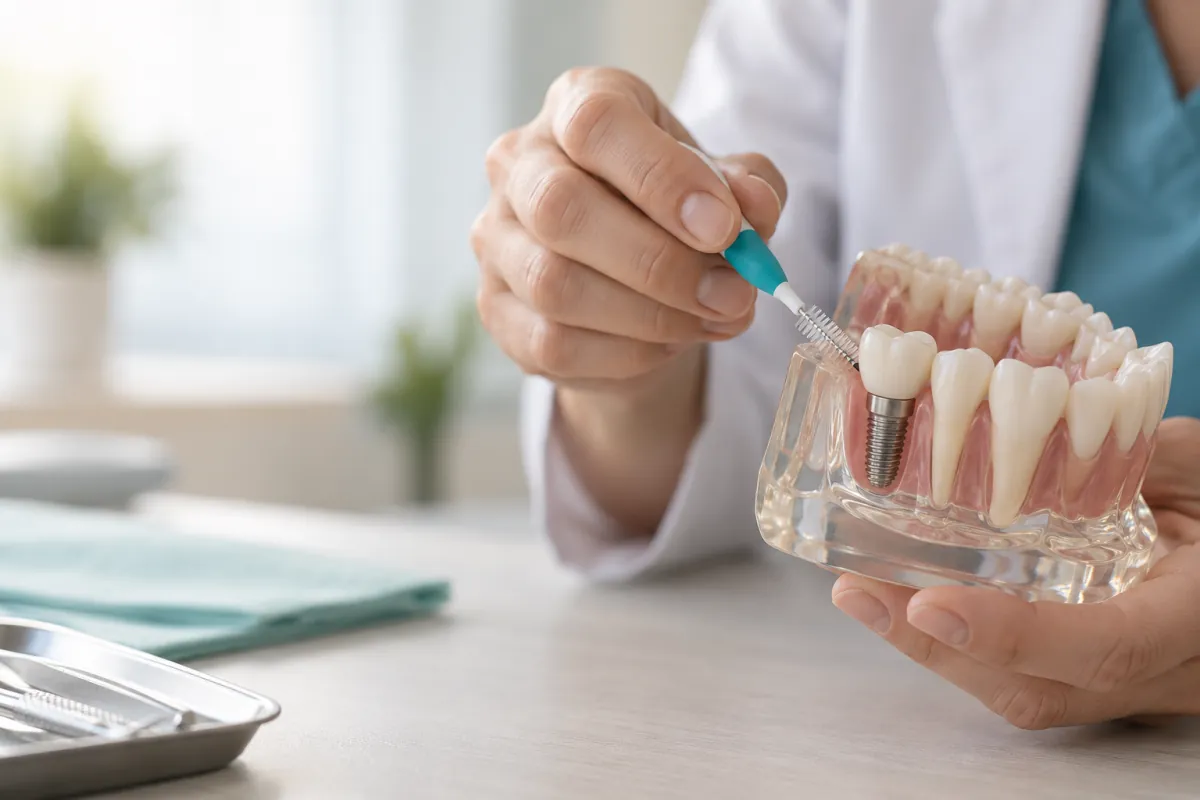
The space around an implant restoration may differ from the space around a natural tooth. Floss, a suitable interdental brush or a water flosser may be recommended, depending on the design and your ability to use the tool effectively.
Ask the hygienist to demonstrate on the actual restoration. Which direction should the brush enter? How far should it go? Is a particular floss technique appropriate? These details matter more than choosing a product because its package says it is suitable for implants.
If floss catches or shreds repeatedly, report it. Do not keep pulling harder or use metal picks to investigate. The dentist may need to check for a rough area, retained material or a restoration contour that makes cleaning unnecessarily difficult.
Bridges and full-arch restorations need a route underneath
A fixed restoration replacing several teeth often creates surfaces that cannot be reached from above with ordinary floss. Cleaning beneath it requires a planned route and enough access for the recommended aids.
Your clinician may demonstrate threaders, specialized floss, small brushes or an irrigator. You do not necessarily need every option. The right combination depends on the shape of the prosthesis, available space and manual dexterity.
If you cannot reach a surface despite following the instructions, say so. Home care should be physically possible. Repeated food trapping or inaccessible areas may require a review of the restoration rather than simply telling you to spend longer cleaning. Bring the tools you use so the team can see the practical problem.
Removable implant dentures have their own routine
If your denture is designed to be removed, take it out according to the instructions you received. Clean the denture, the attachment areas and the tissues or components remaining in the mouth using suitable products and methods.
Do not use boiling water or abrasive household cleaners. The denture material and attachment parts can be damaged by heat or inappropriate chemicals. Ask how to store it when it is out and whether it should be removed overnight in your particular situation.
Attachments can wear over time. A denture that becomes loose may need maintenance of a replaceable component or another adjustment. Avoid applying extra force or modifying the attachment yourself. Report a change in retention before it starts causing rubbing or makes the denture unstable during eating.
What professional maintenance checks
A maintenance visit may include review of your health and medicines, assessment of plaque and bleeding, appropriate measurements around the implant and examination of the restoration’s stability and bite. Imaging is selected when clinically indicated, with previous records used for comparison where available.
Professional cleaning uses instruments and techniques appropriate for the implant and restorative materials. The aim is to remove deposits while protecting surfaces and identifying areas that need further care.
Ask what the findings mean for your next visit. A stable implant with effective home care may have different needs from one with prior inflammation, difficult access or a history of periodontal disease. Maintenance frequency should reflect risk and findings rather than a universal promise that one yearly cleaning suits everyone.
When bleeding or a bad taste appears
Take note of whether the symptom is isolated to the implant area and whether it recurs with gentle cleaning. A little bleeding after an accidental injury is different from a pattern that continues for days or repeatedly returns.
Keep the area gently clean unless your clinician gives different instructions, and arrange assessment for persistent symptoms. Avoid treating the site with harsh rinses, concentrated oils or leftover antibiotics. These can irritate tissues or delay diagnosis without resolving the cause.
Swelling, pus, increasing pain or a persistent unpleasant taste deserves prompt advice. If there is spreading facial swelling, fever or significant illness, mention it when calling. Difficulty breathing or swallowing or rapidly spreading neck swelling requires emergency medical care.
A loose crown needs a mechanical diagnosis
Movement might come from a crown, a connecting screw, another component or the implant itself. These possibilities have different implications. You cannot reliably distinguish them by repeatedly rocking the tooth with your fingers or tongue.
Avoid chewing on the area and call the dental office. If a component comes out, keep it in a clean container and bring it with you. Do not place a loose piece back in the mouth where it could be swallowed or inhaled.
Household glue is not a dental repair. Trying to tighten a part without the correct identification and equipment can damage the restoration or obscure the original problem. Prompt assessment gives the clinician the best chance to identify a manageable mechanical issue before further damage occurs.
Bite forces and habits matter
Implants are strong, but the materials and connections around them still experience repeated loads. Chewing ice, opening packages with teeth and other hard-object habits can damage restorations. A ceramic chip is not automatically a biological problem, but it still deserves review.
Tell the dentist if you clench or grind, wake with jaw soreness or notice wear on other teeth. A protective appliance may be considered for selected patients, with a design that accounts for the implant restoration and overall bite.
If an existing night guard no longer fits after implant treatment, have it checked. Do not force it over the new crown. The dental night guard guide explains why appliance fit and follow-up matter.
Health changes should update the plan
Smoking, a history of periodontal disease and difficulty maintaining plaque control can influence implant health. Diabetes and other medical factors may also affect the wider risk assessment. Share new diagnoses and medication changes at maintenance visits.
If you are trying to stop tobacco use, ask for support that fits your situation. Care should remain practical and respectful. Avoid assuming that switching to another nicotine product removes all oral-health concerns.
Changes in dexterity, vision or daily support can also make a previously successful routine difficult. An implant plan created years earlier may need new tools or caregiver guidance. The goal is to preserve effective care as circumstances change, rather than expecting the same technique to work indefinitely.
Think about maintenance before replacing more teeth
If you are considering an additional implant or a larger restoration, ask how you will clean it and what professional upkeep is expected. Discuss likely access, replacement of worn components and the possibility of future repairs as part of the treatment decision.
No responsible plan can guarantee that a restoration will last forever without attention. Longevity depends on biological health, design, use and follow-up. Understanding maintenance helps you compare options on more than the initial treatment cost.
For patients from Simcoe who receive care in Port Dover, planning regular reviews in advance may make travel easier. Keep the office informed if you cannot attend a recommended review so a suitable alternative can be arranged rather than letting follow-up lapse without discussion.
Frequently asked questions
Can a dental implant get a cavity?
The implant and its restoration do not develop tooth decay, but surrounding tissues can become inflamed and lose support. Natural teeth nearby can still develop cavities.
Is bleeding around an implant normal?
Repeated bleeding with gentle cleaning deserves assessment. It may indicate inflammation, a cleaning problem or another issue around the restoration.
What should I do if my implant crown feels loose?
Avoid chewing on it and contact the dental office promptly. Do not twist, glue or try to tighten the crown yourself; the clinician needs to identify which component is moving.
Arrange implant care near Simcoe
Port Dover Family Dentistry is at 697 Norfolk County Hwy 6, Unit 2, Port Dover. Call 519-583-2929 or request a visit to discuss maintenance or a new concern. Bring your implant records if treatment was completed elsewhere. For care immediately after surgery, see our implant aftercare guide and follow your treating clinician’s instructions.
About the author
Port Dover Family Dentistry Team
Our team provides family-focused dental care in Port Dover, Ontario. We create practical oral-health education to help patients ask informed questions and feel more confident about care. This article is general information and does not replace an examination or personalized diagnosis.