
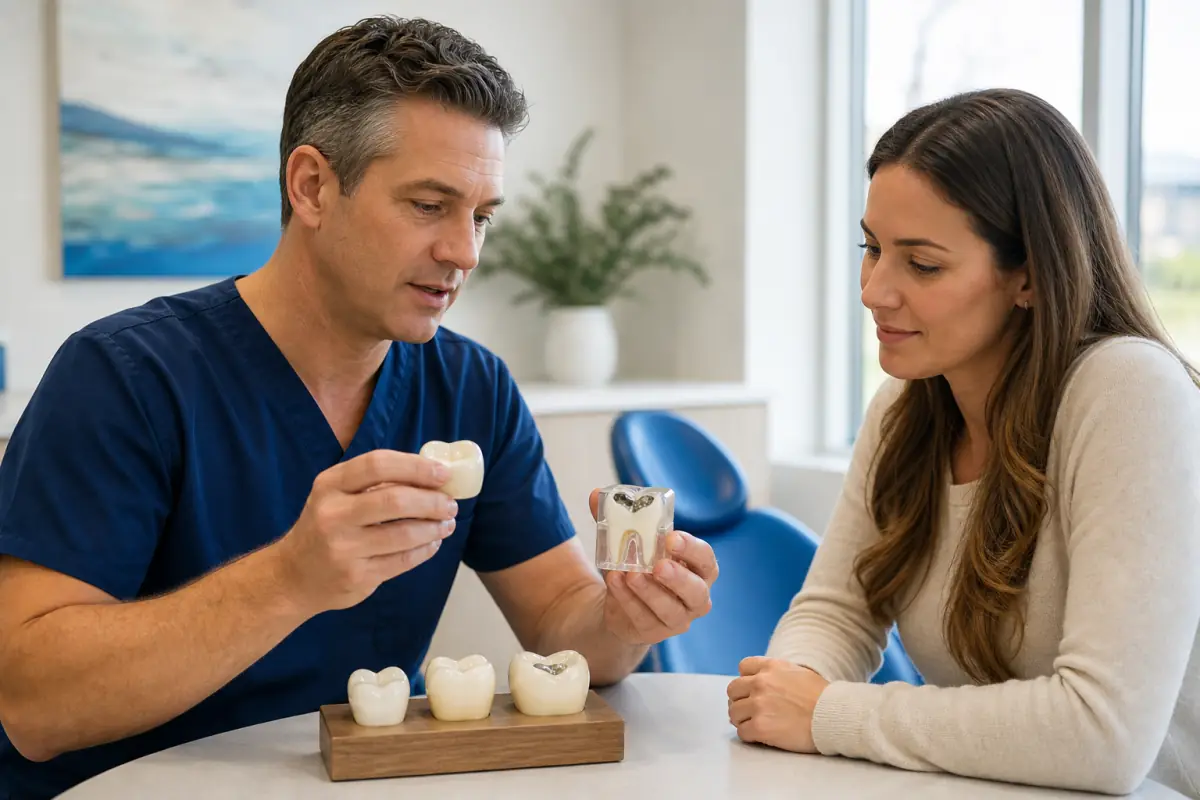
Comparing a dental crown vs filling in Port Dover usually begins with one practical question: how much reliable tooth remains? A filling replaces a localized defect. A crown covers and supports a larger portion of a weakened tooth. Choosing the smaller procedure simply because it is smaller can be false economy if the tooth cannot tolerate biting forces; choosing a crown for a tiny defect would remove more structure than necessary.
An examination, appropriate x-rays and sometimes removal of an old restoration reveal the true condition. This guide explains the decision factors so you can understand a recommendation and ask useful questions.
What is a dental filling?
A filling is placed directly into a prepared area during a dental appointment. Common materials include tooth-coloured composite, amalgam and glass ionomer, each with particular indications.
Fillings are generally suitable when:
- decay or damage is small to moderate;
- enough strong enamel and dentin remain;
- cusps are not significantly undermined;
- the tooth is not split or extensively cracked;
- moisture can be controlled for the selected material; and
- bite forces can be supported predictably.
Our guide to composite fillings in Port Dover explains direct tooth-coloured restoration in detail.
What is a dental crown?
A crown, sometimes called a cap, is a custom restoration that covers prepared tooth structure above the gumline. It can restore shape, create a functional bite and help distribute forces around a tooth that has lost substantial strength.
Crowns can be made from ceramic, zirconia, porcelain fused to metal, metal alloys or other materials. Appearance, thickness, tooth position, bite, opposing restoration and available space influence selection.
A crown may be considered for:
- extensive decay or a large failed filling;
- cracked or fractured cusps;
- a tooth with limited remaining walls;
- selected teeth after root canal treatment;
- severe wear;
- support for a dental bridge; or
- major shape or structural correction.
See our dental crowns service for an overview.
The core difference: replacement versus coverage
Think of a filling as replacing a damaged section within a building wall. A crown is more like reinforcing and covering much of the structure when multiple walls are compromised. The analogy is imperfect, but it explains why size matters.
As a filling grows, the remaining tooth flexes more under chewing. Thin cusps can crack. A crown reduces this flexing by covering vulnerable cusps, although the tooth still can develop decay, fracture or gum problems.
Neither restoration makes a tooth invincible or permanent. The NIDCR notes that fillings and crowns may eventually require replacement.
How much tooth structure remains?
This is one of the most important decision factors. A tooth with a small cavity surrounded by thick, healthy walls is often an excellent filling candidate. A molar with an old restoration occupying most of its width and a cracked cusp may be safer with coverage.
The final extent sometimes becomes clear only after decay or a failing filling is removed. Dentists should explain this possibility before starting and discuss what happens if the defect is larger than expected.
Ask to see intraoral photographs or x-rays when helpful. An x-ray estimates some damage but does not display every crack or confirm the strength of remaining enamel.
Cracks change the decision
Cracked teeth can cause sharp pain when chewing or when releasing pressure, temperature sensitivity or intermittent discomfort. Some cracks remain limited; others extend toward the pulp or root.
A crown can hold weakened cusps together and reduce movement, but it cannot heal a crack. If the crack has reached the pulp, root canal treatment may also be needed. A split tooth or deep root fracture may not be savable.
Early assessment matters because chewing can propagate a crack. Avoid testing a painful tooth repeatedly with hard food.
Filling, inlay, onlay or crown?
The choice is not always binary. An inlay fits within cusps; an onlay covers one or more cusps while preserving more outer tooth than a full crown. These indirect restorations may be ceramic, composite or metal and are fabricated outside the mouth or through digital systems.
| Restoration | Typical coverage | Relative preparation | Common use |
|---|---|---|---|
| Filling | Localized area | Most conservative | Small to moderate defect |
| Inlay | Within cusps | Conservative indirect | Selected moderate defect |
| Onlay | Covers vulnerable cusp(s) | Between filling and crown | Cuspal weakness with preservable walls |
| Crown | Covers most visible tooth | More extensive | Broad structural compromise |
Availability, cost and benefit coverage vary. CDCP currently excludes inlays/onlays and fixed bridges while considering certain crowns through preauthorization, subject to program rules.
What happens during a filling appointment?
After local anaesthetic and isolation as needed, decay or failed material is removed. The filling is placed directly, shaped and bite-checked. It is usually completed in one visit.
Composite requires careful moisture control and adhesive steps. Mild short-term sensitivity can occur, but a high bite, worsening pain or persistent biting discomfort should be reviewed.
What happens during crown treatment?
Traditional crown treatment often takes two visits:
- The tooth is assessed and anaesthetized.
- Decay and failing material are removed.
- A core or buildup may replace missing foundation.
- The tooth is shaped to create space and retention.
- An impression or digital scan records the preparation and bite.
- A temporary crown protects the tooth.
- A laboratory makes the final crown.
- At a later visit, fit, contacts, bite and appearance are checked before cementation.
Some offices offer same-day digital crowns. The biological principles are the same even when fabrication changes.
While wearing a temporary crown, avoid very sticky or hard foods and clean carefully. Call if it comes off, breaks or the bite feels significantly wrong.
Does a crown require a root canal?
No. Many crowned teeth have healthy pulps and never need root canal treatment. However, extensive decay, cracks, previous trauma or preparation near the pulp can increase inflammation risk. Sometimes symptoms develop later despite appropriate care.
Root canal treatment addresses inflamed or infected pulp; a crown addresses structural protection. They solve different problems. A tooth may need one, both or neither.
Back teeth after root canal treatment commonly benefit from cuspal coverage because they often have substantial previous damage and no longer have the same structural integrity. Front teeth are assessed differently.
Which option lasts longer?
It is tempting to compare average lifespans, but studies include different teeth, materials and patient risks. A small filling can outlast a crown in the right situation because it preserves more tooth. A large filling may fail sooner if it overloads thin cusps.
Longevity depends on:
- diagnosis and design;
- remaining tooth and crack status;
- bite and grinding;
- material;
- cement or bonding conditions;
- home plaque control;
- sugar frequency and saliva;
- regular monitoring; and
- avoiding destructive habits.
The best restoration is the least invasive one that can predictably meet the tooth’s needs—not automatically the cheapest, largest or most cosmetic.
Cost and dental-benefit considerations
A filling generally costs less because it is placed directly and requires less fabrication. A crown costs more because of greater clinical time, material and laboratory or digital production.
Benefit plans may reimburse different percentages or require estimates. Coverage does not establish clinical need. Ask for the total fee, expected plan payment, your portion and alternative costs.
Under current Canadian Dental Care Plan coverage, permanent fillings may be eligible within policies. Crowns require preauthorization and clinical criteria. A CDCP co-payment or additional charge may apply, and approval is not guaranteed.
Questions to ask when comparing a crown vs filling
- How many tooth walls and cusps are still strong?
- Is there a crack, and where does it appear to extend?
- How large will the restoration be after decay is removed?
- Is an onlay a reasonable alternative?
- What is the risk of fracture with a filling?
- What is the risk to the pulp with either option?
- What material do you recommend and why?
- What should I expect if the tooth cannot be restored?
These questions do not challenge expertise; they make the trade-off clear.
Caring for a filling or crown
Both restorations need daily care. Decay can start at their margins, and gum inflammation can develop around them.
- Brush twice daily with fluoride toothpaste.
- Clean between teeth daily using a suitable aid.
- Limit frequent sweet or acidic exposures.
- Do not use restored teeth as tools.
- Address grinding or clenching.
- Attend recommended examinations and cleanings.
- Report food trapping, floss shredding, movement or bite changes.
A crown cannot decay, but the tooth underneath can. Its margin deserves careful plaque removal.
When not to delay an assessment
Arrange care for a lost filling or crown, pain on biting, spontaneous ache, worsening cold sensitivity, swelling, a visible crack or a tooth fragment. Waiting may allow a repairable problem to become a root canal or extraction.
For severe swelling, fever, trouble breathing or trouble swallowing, seek urgent help. Our dental emergency guide for Port Dover explains triage and safe first aid.
Dental crowns and fillings in Port Dover
At Port Dover Family Dentistry, the crown-versus-filling decision begins with preserving healthy structure while planning for reliable function. We explain the visible damage, reasonable alternatives and uncertainties before treatment.
If a tooth is cracked, heavily filled or sensitive, call 519-583-2929 or request an appointment. An examination is the only way to determine whether a filling, crown or another option is appropriate.
Frequently asked questions
Is a crown better than a filling?
Not inherently. A crown is better when broad coverage is needed; a filling is better when damage is limited and enough strong tooth remains. The correct choice matches the condition.
Can a large filling be changed to a crown later?
Sometimes, but a fracture or deeper decay may occur before replacement. If the current tooth is already structurally compromised, delaying coverage can change its restorability.
Why does a crowned tooth still hurt?
A new crown may need bite adjustment, while pulp inflammation, a crack, gum irritation or another tooth can also cause pain. Persistent or worsening symptoms require assessment.
About the author
Port Dover Family Dentistry Team
Our team provides family-focused dental care in Port Dover, Ontario. We create practical oral-health education to help patients ask informed questions and feel more confident about care. This article is general information and does not replace an examination or personalized diagnosis.