
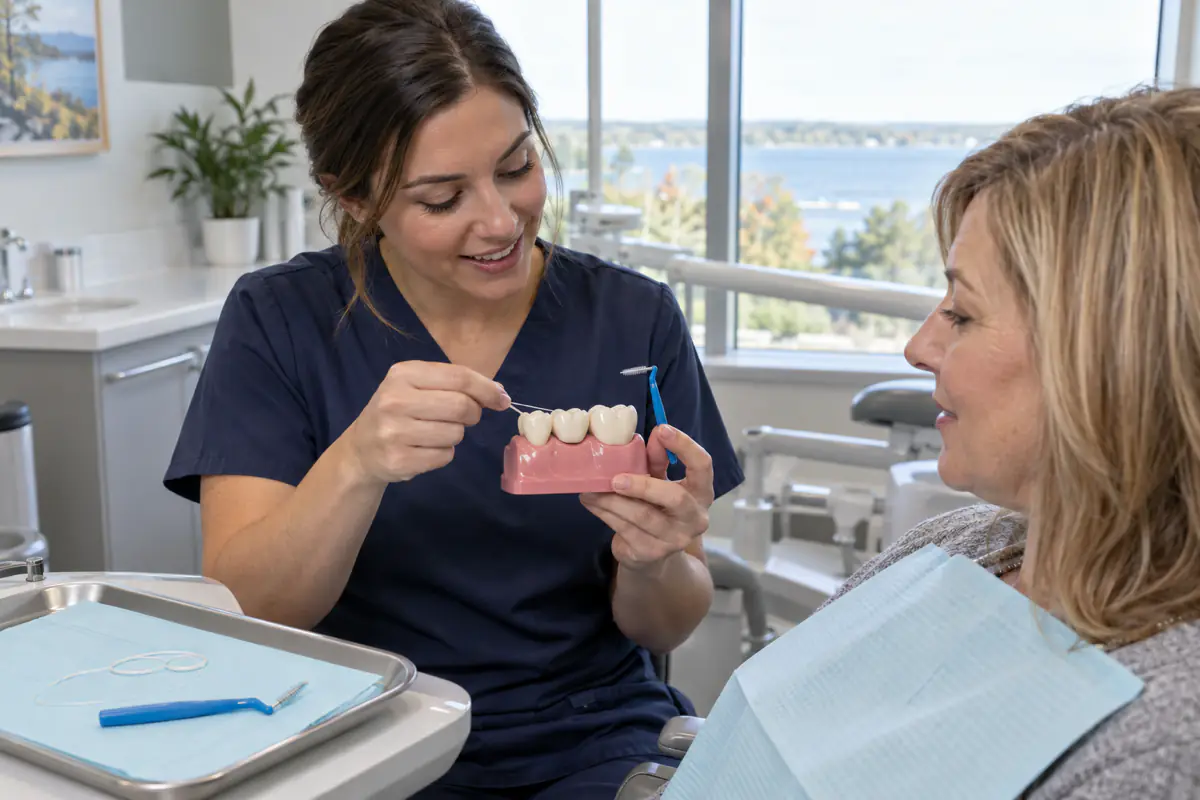
A fixed bridge can restore chewing and appearance after tooth loss, but it introduces surfaces that an ordinary piece of floss cannot pass through from the biting edge. Effective dental bridge care in Simcoe focuses on protecting the supporting teeth and cleaning beneath the replacement tooth every day.
A bridge can feel like one continuous row of teeth, yet the biology underneath remains active. Plaque can accumulate at crown margins and against the gum. Decay or gum disease in one supporting tooth may threaten the entire restoration, so prevention is more important than waiting for the bridge itself to hurt.
How a traditional bridge works
A conventional fixed bridge usually includes a replacement tooth, called a pontic, joined to crowns on teeth beside the gap. Those supporting teeth are called abutments. The bridge is cemented in place and is removed only by a dentist.
Other designs include cantilever bridges supported on one side, resin-bonded bridges with wings attached to neighbouring teeth, and implant-supported bridges. Cleaning methods and risk points differ, so identify which type you have.
The American Dental Association’s MouthHealthy resource describes a bridge as a fixed partial denture that replaces one or more missing teeth and depends on a healthy, strong foundation. The long-term success of the replacement is closely tied to the teeth, implants, bone and gums supporting it.
Why ordinary flossing is different
Natural teeth are separate, allowing floss to slide down from the contact. Bridge units are joined, so floss cannot pass through from above between the pontic and abutment crowns. It must be threaded underneath from the side.
The goals are to:
- remove plaque from the underside of the pontic;
- clean the gum beneath it without cutting tissue;
- clean around crown margins on supporting teeth; and
- disrupt plaque where the bridge meets natural tooth structure.
Brushing cleans outer, inner and biting surfaces but cannot reliably reach all of these areas.
Using a floss threader
A floss threader is a thin flexible loop. Place floss through the loop, guide the firm end beneath the bridge and pull the floss through. Once under the pontic, move the floss gently back and forth against the underside. Curve it around each supporting tooth and move it up and down along the side.
Do not saw aggressively into the gum. The floss should contact the bridge and tooth surfaces, not repeatedly cut one tissue spot. Pull it out from the side when finished rather than forcing it upward through the joined contact.
Stiff-ended specialty floss combines a built-in threader with a spongy section for the pontic and regular floss for neighbouring teeth. Some patients find this easier than assembling two pieces.
Interdental brushes
A small interdental brush can clean beneath a pontic when there is enough space. The brush should slide through with gentle resistance, not bend sharply or require force. Too large a brush can traumatize gum; too small may miss plaque.
Insert it from the cheek or tongue side as demonstrated and move it through the space several times. Rinse after use and replace it when bristles are worn. Different parts of the bridge may require different sizes.
Do not push a wire into a tight space around exposed implant surfaces or soft tissue without professional sizing. Bring the brushes you use to a hygiene visit for feedback.
Water flossers
A water flosser can remove loose debris and disrupt plaque around a bridge. Aim along the gumline and beneath the pontic using a pressure that is comfortable. Begin on a low setting and lean over the sink.
Water flossing is useful for limited dexterity, but technique still matters. It may complement rather than completely replace physical contact with floss or an interdental brush, depending on bridge design. Ask the hygienist to tailor a routine that you can actually maintain.
Do not direct a very high-pressure jet into sore or recently treated tissue without advice.
Brushing around the margins
Use a soft manual or powered brush twice daily with fluoride toothpaste. Angle bristles toward the gumline around each supporting crown and brush the tongue side carefully, where plaque is easy to miss.
An end-tuft brush—a small cluster of bristles—can reach the back edge of an abutment and tight contours. Avoid hard bristles and abrasive powders, which can scratch restorative surfaces and injure gums.
Spit after brushing and follow the fluoride product instructions. If decay risk is high because of dry mouth or previous root cavities, the dentist may recommend a prescription-strength fluoride product.
Cleaning implant-supported bridges
Implants do not develop tooth decay, but the tissues and bone around them can become inflamed and lose support. Implant bridges require cleaning under the prosthesis and around each implant connection.
Use tools recommended for implant materials. Exposed metal wires or harsh abrasives may scratch surfaces. Bleeding, swelling, pus, a bad taste or increasing pocket depths around an implant needs prompt assessment.
An implant bridge may be screw-retained or cemented and may have a different underside contour from a tooth-supported bridge. A generic online demonstration may not match yours. Ask for instruction with your own bridge and a mirror.
Food under the bridge
Some space beneath a pontic is necessary for cleaning, but a gap that suddenly traps much more food may reflect gum change, wear or a damaged contour. Rinse after meals and use the chosen interdental tool rather than digging with pins or sharp objects.
Sticky foods can pull on a loose bridge, while very hard foods can chip porcelain or fracture supporting teeth. You do not necessarily need to avoid every firm food, but do not crack ice, nutshells or packaging with the bridge.
If food impaction creates pain or odour despite good technique, have the shape and fit assessed.
Signs of decay under a bridge
The crowned supporting tooth can decay at the margin where restoration meets natural tooth. Early decay may have no pain. Warning signs can include sensitivity, a bad taste from one area, floss catching, visible darkening at the edge or recurrent gum inflammation.
X-rays may help identify decay, but metal or dense ceramic can obscure part of the tooth. The dentist combines imaging with examination and history. A bridge does not need to be removed at every checkup, but suspicious findings may require further investigation.
Small accessible decay may occasionally be repaired, while extensive decay can require removal of the bridge, root canal treatment or extraction. Early detection preserves more options.
Gum inflammation and bleeding
Bleeding around bridge margins usually means inflammation or mechanical injury. Plaque is common, but trapped cement, poor contour, roughness or an ill-fitting restoration may contribute. Do not stop cleaning merely because the gum bleeds; switch to a gentle method and arrange review if it persists.
Professional cleaning removes calculus and allows the team to assess periodontal support. Advanced gum disease around an abutment can compromise the bridge even when the porcelain looks perfect.
See bleeding gums in Simcoe for causes, home technique and urgent signs.
What a loose bridge feels like
A bridge may move, click, taste unusual or feel different when biting. Sometimes only one abutment has loosened while the other remains attached, creating a lever that can damage the supporting tooth.
Stop chewing on it and call promptly. Do not wiggle it repeatedly or apply household glue. If it comes out completely, keep it in a clean container and bring it to the appointment.
Recementation may be possible if the bridge fits, the cement simply failed and the abutments remain sound. Decay, fracture, distortion or loss of support may require a new plan. A loose bridge is not safely diagnosed over a photo.
Chipped porcelain and wear
A small porcelain chip may feel rough to the tongue. Depending on location and depth, the dentist might polish it, bond a repair, send the bridge for laboratory work or replace it. Do not file it at home.
Grinding and clenching increase load on bridges and opposing teeth. A professionally fitted night guard may be recommended, especially when wear or previous fracture is evident. The guard must fit the restored bite; an old appliance may no longer seat after a new bridge.
Read dental night guards in Simcoe for fitting and maintenance details.
Sensitivity and pain
Mild temperature awareness can occur after bridge preparation while supporting teeth settle. It should generally improve. Lingering heat or cold pain, spontaneous throbbing, biting pain or swelling requires assessment.
A supporting tooth may develop pulp inflammation, decay or a crack. Gum recession can expose a sensitive root beside the crown. Pain can also come from an opposing tooth or jaw muscle, so diagnosis precedes treatment.
If root canal treatment is required, it may sometimes be performed through the crown, though restoration integrity and future prognosis must be considered. In other cases the bridge is removed.
How long bridges last
No ethical clinician can promise an exact lifespan. A bridge’s longevity depends on:
- health and structure of supporting teeth;
- periodontal and bone support;
- quality and fit of the restoration;
- bite forces and grinding;
- number and length of missing spaces;
- cavity risk and saliva;
- daily cleaning; and
- professional monitoring.
Some bridges serve for many years, while others fail earlier. A replacement may require additional tooth preparation, so preserving the first bridge through prevention is worthwhile.
Routine dental checks
At recall appointments, the team examines margins, gum inflammation, mobility, bite, chipping and hygiene access. Periodontal measurements track support. X-rays are selected according to risk and need rather than taken automatically.
Bring concerns early. A minor rough edge or local bleeding is often simpler to address than a loose bridge with decay beneath it. Professional cleaning frequency should reflect periodontal and cavity risk.
If you see another dental provider, tell them the bridge’s approximate age and whether any supporting tooth has had root canal treatment.
If the bridge cannot be saved
Failure does not automatically mean another identical bridge. Options may include a new bridge, implant-supported replacement, removable partial denture or, in selected cases, leaving the space. Bone, neighbouring teeth, health, cost and personal priorities shape the decision.
An implant avoids preparing adjacent teeth but involves surgery and needs adequate bone and healthy tissue. A removable partial is less invasive but feels and cleans differently. Review missing tooth replacement in Norfolk County for a balanced comparison.
A daily bridge-care routine
An effective routine can be simple:
- Brush all bridge surfaces and margins morning and night with fluoride toothpaste.
- Once daily, thread floss beneath every pontic and around abutments.
- Use an interdental brush or water flosser where professionally recommended.
- Clean the tongue and remaining natural teeth.
- Rinse tools and let them dry.
- Note new bleeding, odour, sensitivity, movement or food trapping.
- Keep recall and professional cleaning visits.
Consistency matters more than collecting many devices. Ask the hygienist to narrow the choices to a routine that fits your hands and bridge.
Get bridge-care help near Simcoe
Port Dover Family Dentistry serves Simcoe and communities throughout Norfolk County. We can identify your bridge design, demonstrate cleaning beneath it, evaluate supporting teeth and investigate looseness, pain or persistent food trapping.
Call 519-583-2929 or request an appointment for bridge maintenance. If the bridge becomes loose, breaks or is associated with swelling, call directly and avoid chewing on it until it can be assessed.
About the author
Port Dover Family Dentistry Team
Our team provides family-focused dental care in Port Dover, Ontario. We create practical oral-health education to help patients ask informed questions and feel more confident about care. This article is general information and does not replace an examination or personalized diagnosis.