
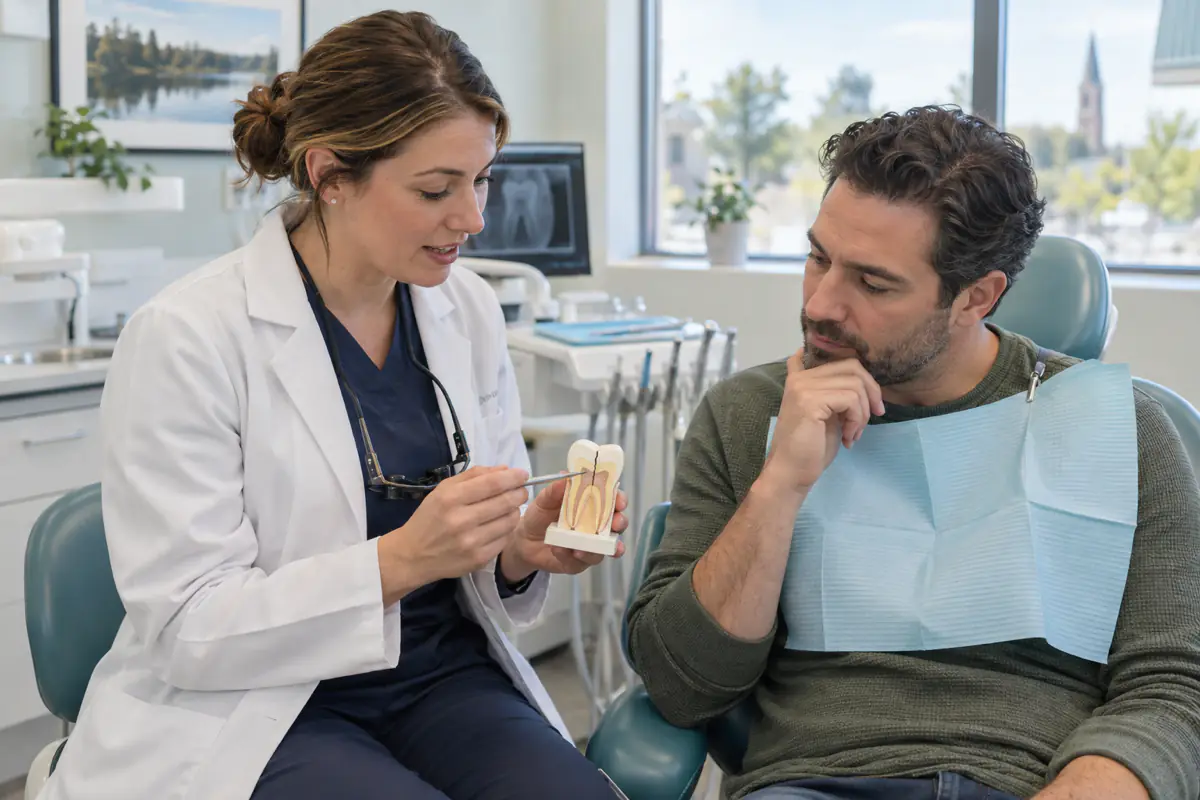
A cracked tooth in Simcoe does not always announce itself with constant pain. You may feel a sharp twinge when biting a certain way, notice cold sensitivity that comes and goes, or struggle to identify which tooth hurts. Some cracks are harmless lines in the enamel; others extend toward the nerve or root and threaten the tooth.
Because these symptoms overlap with cavities, loose fillings, gum problems and sinus pressure, a home diagnosis is unreliable. A dental examination is the safest way to determine what is happening. Early assessment matters because chewing can allow a structural crack to travel farther, but timely treatment may protect a tooth that is still restorable.
What does “cracked tooth” actually mean?
Patients often use crack, chip and break interchangeably. Dentists separate them because the pattern affects treatment and prognosis.
- Craze lines are shallow enamel lines commonly seen in adult teeth. They usually do not hurt or require structural treatment.
- A fractured cusp occurs when part of the chewing surface breaks, often beside a large filling. The damaged area may be restored with a filling or crown.
- A cracked tooth has a line that begins on the chewing surface and extends downward. The tooth has not separated into independent pieces.
- A split tooth has progressed into segments that can move apart. The entire tooth often cannot be retained, although an individual segment may occasionally be treatable.
- A vertical root fracture begins in the root and may remain quiet until the surrounding gum and bone become inflamed.
The American Association of Endodontists’ cracked-tooth guide explains why location and depth—not simply whether a line is visible—shape the outcome.
Common symptoms of a cracked tooth
The classic symptom is a brief, sharp pain while chewing, particularly as bite pressure is released. That pattern occurs because the cracked sections can flex microscopically and irritate the pulp, the soft tissue containing the tooth’s nerves and blood vessels.
Other possible signs include:
- sensitivity to cold, heat or sweets;
- pain that appears only with hard, crunchy or chewy food;
- discomfort that is difficult to locate;
- soreness around one tooth without an obvious cavity;
- a rough edge or missing piece;
- new pain around a large filling;
- spontaneous throbbing as the pulp becomes inflamed; or
- a small recurring gum bump when infection develops.
Not every crack causes symptoms. Conversely, pain when biting does not prove a crack exists. Decay, a high filling, an inflamed ligament, an abscess or a loose restoration can feel similar.
Why teeth crack
Teeth tolerate enormous repeated forces, but they are not indestructible. A single injury can cause a fracture, or small stresses can accumulate over years.
Frequent contributors include biting ice, popcorn kernels, hard candy or non-food objects; clenching and grinding; trauma from sports or a fall; and large restorations that leave less natural tooth structure. Age-related wear and temperature extremes can add stress. For example, biting something very hard and then exposing the tooth to a sudden temperature change may trigger symptoms in an already weakened area.
A root-canal-treated tooth can become more vulnerable when substantial structure was lost before treatment. That is why the final restoration recommended after a root canal is an important part of protecting the tooth.
Why the pain can come and go
A cavity often becomes progressively sensitive as it gets deeper. A crack behaves differently. One bite may separate the cracked surfaces slightly, while the next bite misses the exact angle. Symptoms can disappear for days and return with a particular food.
This intermittent pattern sometimes leads people to delay care. Unfortunately, the absence of pain does not confirm that the problem resolved. Tooth structure cannot fuse back together. If the crack continues to flex, irritation inside the tooth may progress from reversible inflammation to irreversible pulp damage or infection.
Record which foods, temperatures and movements trigger the pain. Those details can help the dentist reproduce and localize the symptom.
How a dentist investigates a suspected crack
Diagnosis begins with the history: when the pain started, whether there was an injury, which bite movements provoke it, and whether cold discomfort disappears quickly or lingers. The dentist then examines the tooth, surrounding gums, bite and existing restorations.
Tests may include:
- gently biting on a small instrument one cusp at a time;
- cold testing to assess pulp response;
- tapping and pressure tests;
- magnification and focused lighting;
- shining light through the tooth to reveal interrupted transmission;
- checking periodontal pocket depths for an isolated deep area;
- dental X-rays; and
- removing a failing restoration when clinically justified.
Regular two-dimensional X-rays often do not display a fine vertical crack directly. They remain valuable for finding decay, bone changes, infection and other explanations. In selected cases, three-dimensional imaging or referral to an endodontist may provide more information, although no test makes every crack visible.
Craze line, cavity or true crack?
A visible line on a front tooth may be a harmless craze line, especially when there is no pain or missing structure. Dark staining alone does not reveal depth. Dentists look at symptoms, transillumination, structural loss and pulp health before recommending treatment.
A cavity is a disease process in which bacterial acids demineralize tooth structure. A crack is a mechanical disruption. The two can occur together: bacteria and fluid may move along a fracture, while decay can weaken a cusp until it breaks.
Avoid assuming that every visible line needs a crown, or that a normal-looking tooth is healthy. Treatment should follow a diagnosis, not a photograph or an online checklist.
Treatment for a fractured cusp
When a cusp breaks around a filling but the crack does not extend deeply into the pulp or root, the outlook can be favourable. A small defect may be repaired with a bonded restoration. Greater structural loss may call for an onlay or crown that covers and supports the chewing surface.
If the break exposed or irreversibly inflamed the pulp, root canal treatment may be needed before the tooth receives its final protective restoration. The dentist also checks the bite and considers why the cusp failed so the repaired tooth is not immediately overloaded.
Keep any fragment you find and bring it to the appointment. In some situations a fragment can help the assessment or be bonded back, although that is not always possible.
Treatment for a cracked tooth
For a restorable crack that remains above the gumline, treatment often focuses on reducing flexure. A crown or bonded onlay can hold the cusps together and distribute chewing forces. A temporary restoration may first be used to see how the tooth responds.
If the pulp is irreversibly inflamed or infected, root canal treatment can remove the damaged tissue inside the tooth. The tooth then generally requires cuspal coverage. Root canal treatment addresses the pulp; it does not erase the structural crack.
No restoration guarantees that a crack will never progress. The likely benefits, uncertainties and alternatives should be discussed before treatment. A shallow, promptly treated crack has a different prognosis from one that reaches the root or creates an isolated deep periodontal defect.
When a tooth cannot be saved
A tooth may need extraction when it is split into separate segments, the crack travels too far below the gum or through the root, decay leaves inadequate support, or infection and bone loss make restoration unpredictable.
If removal is recommended, ask what features make the tooth non-restorable and what will happen after healing. Replacement choices can include an implant, bridge or removable partial denture, depending on the site, health, bone, neighbouring teeth, goals and budget. Our overview of missing-tooth replacement options can help you prepare for that conversation.
Extraction should not be assumed merely because pain is severe. Some very painful teeth remain treatable, while some deeply fractured teeth cause surprisingly little discomfort.
What to do before your appointment
Call promptly and describe the symptoms and any injury. Until the tooth is assessed:
- Avoid chewing on that side.
- Choose softer foods and avoid ice, hard candy and kernels.
- Keep the area clean with gentle brushing.
- Rinse with plain lukewarm water after eating.
- If a sharp edge rubs your cheek, temporary dental wax can provide a short barrier.
- Ask a pharmacist or qualified clinician which over-the-counter pain medicine is safe with your health conditions and current medications.
Do not glue a fragment or restoration back into place. Never place aspirin on the gum; it can burn the tissue. Avoid repeatedly “testing” the tooth with hard food, as that can worsen the fracture.
When cracked-tooth symptoms are urgent
Prompt dental assessment is appropriate for a new chip, pain on biting or unexplained temperature sensitivity. The situation becomes more urgent when pain is severe, a large piece is missing, the tooth is loose, or swelling and fever suggest infection.
Seek emergency medical help for trouble breathing or swallowing, swelling that spreads toward the eye or neck, uncontrolled bleeding, loss of consciousness, or significant facial and jaw trauma. A dental office treats the tooth, but potentially life-threatening injury or spreading infection may require hospital care.
If the tooth was knocked completely out rather than cracked, time is critical. Follow the first-aid steps in our knocked-out tooth guide for Simcoe patients and contact a dentist immediately.
Preventing another crack
Not every fracture can be prevented, but reducing concentrated forces helps:
- do not chew ice, pens, nutshells or unpopped kernels;
- wear a properly fitted mouthguard for contact and collision sports;
- mention morning jaw fatigue or flattened teeth, which may indicate grinding;
- do not use your teeth to open packages;
- replace failing restorations when clinically necessary;
- complete the recommended final restoration after root canal treatment; and
- maintain regular examinations so weakening teeth can be monitored.
A night guard may protect selected people who grind, but it must fit the bite and does not stop every crack. An over-the-counter appliance can be bulky or inappropriate for certain dental conditions. Ask for an assessment rather than treating clenching by guesswork.
A cracked tooth consultation near Simcoe
People looking for help with a cracked tooth in Simcoe may prefer a nearby practice that can assess pain, take appropriate images, stabilize the tooth and arrange specialist care when needed. Port Dover Family Dentistry welcomes patients from Simcoe and surrounding Norfolk County communities.
At the visit, bring a medication list, describe recent trauma or grinding, and explain the exact trigger. If a previous office has relevant X-rays, arranging their transfer may reduce duplication, although new images are sometimes necessary.
Call 519-583-2929 or request an appointment. A request is not confirmed until our team contacts you, and urgent symptoms should be described by phone.
Frequently asked questions
Can I wait if the pain stopped?
Intermittent symptoms are common with cracks. Stopping pain does not prove the tooth healed, and loss of nerve response can also change symptoms. Arrange an assessment rather than waiting for another painful bite.
Will an X-ray always show a cracked tooth?
No. Fine cracks may run in a direction or be too narrow to appear on a standard image. X-rays are still useful for identifying infection, decay, bone changes and other causes of pain.
Is bonding enough to repair a crack?
Bonding can restore a small chip or selected defect. A crack that weakens the cusps may need an onlay or crown, and pulp damage may require root canal treatment. The appropriate option depends on an in-person diagnosis.
About the author
Port Dover Family Dentistry Team
Our team provides family-focused dental care in Port Dover, Ontario. We create practical oral-health education to help patients ask informed questions and feel more confident about care. This article is general information and does not replace an examination or personalized diagnosis.