
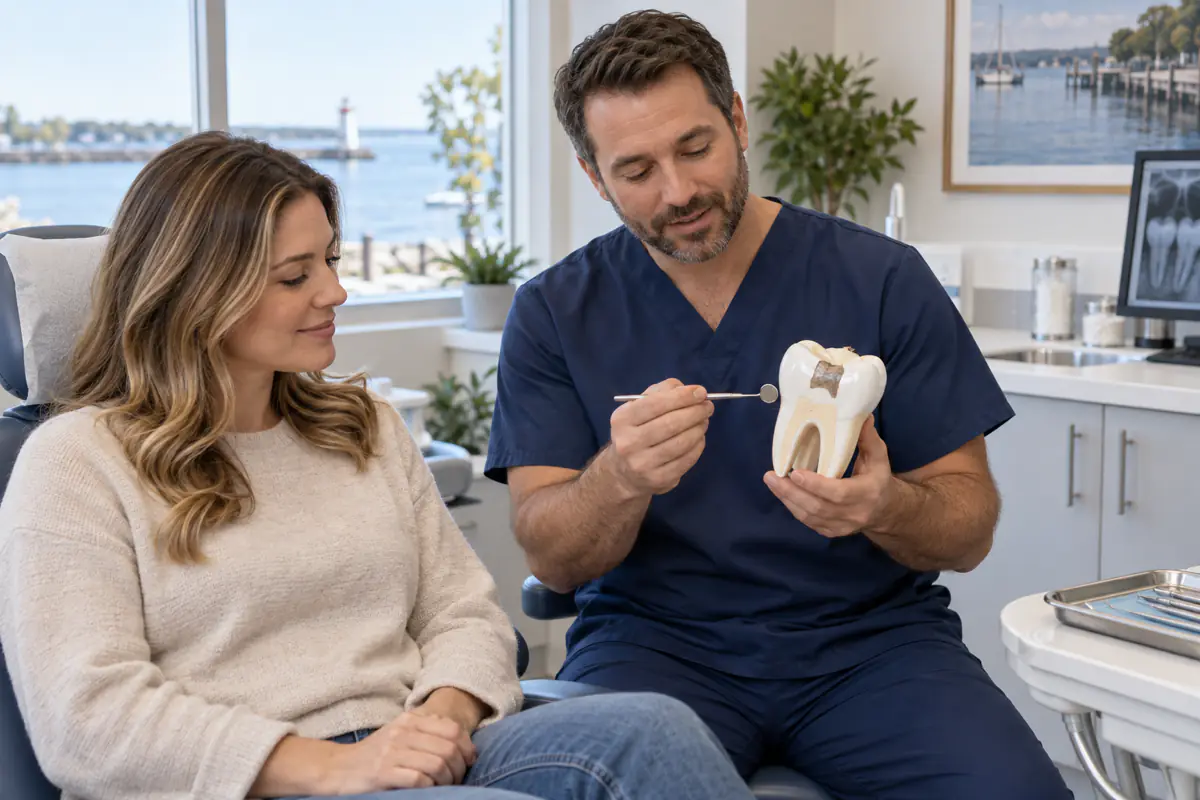
A broken filling in Port Dover can announce itself with a sharp edge, a sudden hole, food catching between teeth or a piece of material in your meal. Sometimes the first sign is sensitivity to cold or pressure. At other times there is no pain at all. An intact-looking tooth can still have a loose filling or a crack beneath it, so comfort alone does not show that the tooth is safe.
The sensible response is to protect the area, arrange an examination and avoid improvised repairs. Early assessment often preserves more tooth structure and makes the treatment decision clearer.
What a dental filling does
A filling replaces tooth structure lost to decay, wear or a small fracture. The dentist removes unhealthy material, shapes the area and places a restorative material that helps seal and rebuild the tooth. Common direct materials include tooth-coloured composite resin and dental amalgam.
The National Institute of Dental and Craniofacial Research explains that fillings treat cavities and that badly broken-down teeth may instead require crowns. It also notes that fillings and crowns can eventually need replacement. No restoration lasts forever because it continues to face chewing forces, temperature changes, oral bacteria and changes in the surrounding natural tooth.
Signs a filling may be damaged
Contact a dental office if you notice:
- a new hole, ledge or rough surface;
- a missing piece of silver or tooth-coloured material;
- floss that catches, tears or suddenly slips through a contact;
- food repeatedly packing beside the restoration;
- pain when biting or when you release your bite;
- sensitivity to cold, heat or sweets that is new or lingering;
- a tooth that feels different when your teeth meet; or
- swelling, a bad taste or a pimple-like spot on the gum.
A dark margin does not automatically mean decay, and tooth-coloured material can be hard to distinguish from enamel. Conversely, a filling may look acceptable while its seal has failed. Diagnosis requires more than a mirror at home.
Why fillings crack, loosen or fall out
Several problems can produce the same result. Decay may develop at an edge and remove the support under a filling. Repeated heavy biting can fatigue a large restoration or the remaining cusps. Grinding and clenching add force, especially overnight. A hard food, ice cube or accidental impact may be the final event in a tooth that was already weakened.
Restorations also age. Composite can wear or chip, while amalgam and the surrounding tooth can develop marginal gaps or fractures. Dryness or contamination during placement can affect bonding, but a failed filling does not by itself prove that something was done incorrectly. Tooth anatomy, restoration size, bite, oral hygiene, diet and time all influence service life.
Occasionally what feels like a lost filling is actually a broken cusp, a fractured crown or a piece of natural tooth. That distinction changes treatment, which is why sending a clear description to the office is useful but cannot replace an examination.
What to do right away
Rinse gently with lukewarm water to clear loose debris. If you find a fragment, place it in a clean container and bring it to the visit; it may help identify what broke even if it cannot be rebonded. Brush carefully with a soft toothbrush and continue cleaning between nearby teeth if floss can pass without snagging.
Until assessed:
- chew on the other side;
- choose softer foods;
- avoid ice, hard candy, popcorn kernels and sticky foods;
- limit very hot, cold or sugary items if they trigger sensitivity; and
- cover a sharp edge temporarily with orthodontic wax or a small piece of sugar-free gum.
If you normally can take an over-the-counter pain reliever, follow the label and advice from your pharmacist or physician. Do not place aspirin against the gum; it can injure tissue. Pregnancy, kidney or liver disease, ulcers, blood thinners, allergies and other medicines can change which pain relievers are appropriate.
Temporary filling products have limits
Some pharmacies sell temporary dental cement. When a dentist is not immediately available, the product may cover a small opening for a short period if the package directions are followed. The area should be clean, and the material should not be forced deeply into the tooth.
Temporary cement cannot remove decay, seal a crack predictably or treat an inflamed nerve. It may also fall out and can complicate cleaning if overfilled. Never use superglue, craft adhesive, nail products or another household material in the mouth. These products are not designed for living tissue and may make definitive treatment harder.
When the problem is urgent
Call promptly for severe, spontaneous or worsening toothache; pain that wakes you; swelling of the face or gum; fever; pus or a foul taste; trauma; or inability to close comfortably. Trouble breathing or swallowing, rapidly spreading swelling, major facial injury and uncontrolled bleeding require emergency medical attention.
A painless lost filling still deserves a timely appointment. Exposed dentin may become sensitive, and an unsupported wall can break during normal chewing. If symptoms follow an injury, review our guidance on a dental emergency in Port Dover.
How the dentist evaluates the tooth
The visit begins with what happened, how long symptoms last and whether biting, temperature or sweets provoke them. The dentist checks the restoration, remaining tooth, gum and bite. A bright light, magnification and gentle instruments can reveal open margins or fractures.
Dental X-rays may be recommended to look for decay between teeth, changes around the root and the depth of the restoration. X-rays cannot show every crack. Additional tests—such as cold testing, tapping, bite testing or transillumination—may help assess the dental pulp and locate a fracture.
The objective is to answer three questions: Is the tooth restorable? Is its nerve healthy enough for a routine restoration? Is enough strong tooth left to support the repair?
Repair, replacement or a larger restoration
A very small chip at an otherwise sound composite margin may occasionally be repaired. More often, a loose or substantially broken filling is removed so the tooth underneath can be inspected. Decay and unsupported material must be cleaned away before a reliable new seal is created.
If the defect is limited and sufficient tooth remains, a new direct filling may be appropriate. Read about composite fillings in Port Dover to understand how tooth-coloured resin is placed and maintained.
When a filling occupies much of the tooth or a cusp has broken, another large filling may concentrate stress in thin walls. An onlay can cover selected cusps, while a crown surrounds more of the tooth. Our comparison of a dental crown versus a filling in Port Dover explains why the amount and quality of remaining tooth—not simply the size of the hole—guides that choice.
When the nerve or root is involved
A deep cavity, crack or fracture can inflame the pulp inside the tooth. Brief cold sensitivity does not automatically mean root canal treatment is needed. Lingering temperature pain, spontaneous aching, tenderness to pressure or loss of vitality can indicate more advanced pulp injury.
If the tooth can be predictably restored but the pulp cannot recover, root canal treatment may be discussed before the final restoration. A crack extending deeply below the gum or a vertical root fracture can make the tooth unrestorable. Extraction is not the default for a broken filling, but it may be the honest option when there is not enough healthy structure or support.
Treatment should not begin with a promise based on symptoms alone. The final plan follows removal of failing material, diagnostic findings and a discussion of prognosis, cost, timing and alternatives.
Composite and amalgam decisions
The old material does not always dictate the replacement. Composite bonds to prepared tooth and matches its colour. It requires careful moisture control and may be less suitable where isolation or biting forces are challenging. Amalgam is durable in many posterior situations but is metallic and is used less commonly in some practices.
Removing an intact restoration solely because of its material sacrifices some healthy tooth. If an older filling is sound and the surrounding tooth is healthy, monitoring may be more conservative than replacement. When it is failing, the material decision should reflect cavity size, location, remaining enamel, moisture control, appearance, bite and patient preferences.
Preventing another fracture
No habit can guarantee a filling will last, but risk can be reduced. Brush twice daily with fluoride toothpaste and clean between teeth every day so decay is less likely to start at restoration edges. Keep routine examinations, where small changes can be compared over time.
Avoid chewing ice and using teeth to open packages. If you grind, ask whether signs of wear justify a custom night guard; a guard manages force but does not cure clenching. Frequent sugar exposure feeds decay risk, so consider how often sweet drinks and snacks contact the teeth, not just the total amount.
Have persistent bite discomfort checked. A restoration that receives excessive force may need adjustment, and an overlooked crack can progress. Continue attending maintenance after a replacement because the tooth-restoration junction remains vulnerable.
Planning your visit in Port Dover
When you call, tell the team which tooth seems affected, when it occurred and whether there is pain, swelling, trauma or a sharp edge. Mention medical conditions, allergies and current medicines. These details help determine appointment timing and safe advice.
At the visit, ask what portion is filling versus natural tooth, whether a crack is present, how the pulp tested and why the proposed restoration fits the remaining structure. A clear plan should also address what would change the prognosis.
Port Dover Family Dentistry can assess a lost, loose or broken filling in Port Dover, explain the findings and review appropriate repair options. Call 519-583-2929 or request an appointment.
This article provides general education and cannot diagnose a specific tooth. Seek individualized dental or medical advice for your symptoms.
About the author
Port Dover Family Dentistry Team
Our team provides family-focused dental care in Port Dover, Ontario. We create practical oral-health education to help patients ask informed questions and feel more confident about care. This article is general information and does not replace an examination or personalized diagnosis.