
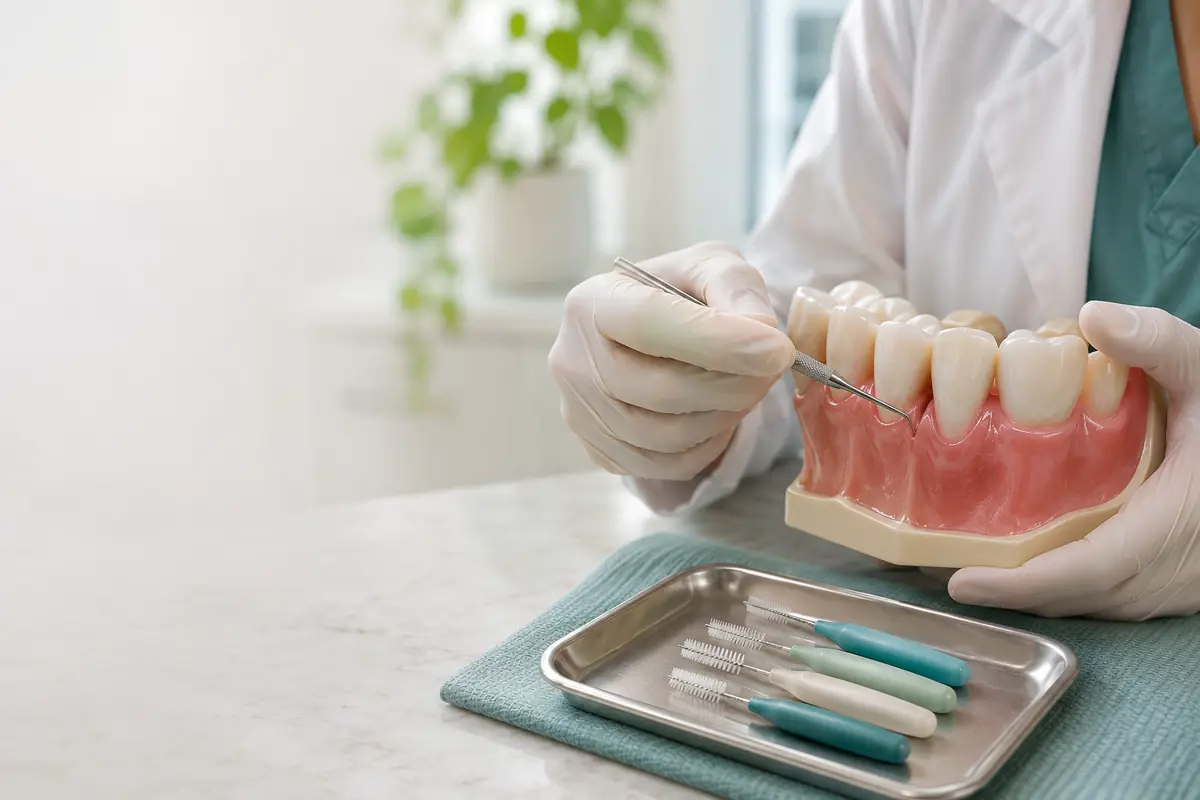
A black triangle is a small, dark, triangular space between two teeth just above the gumline (or below it, on the lower teeth). It appears where the pointed piece of gum that normally fills the gap between teeth, called the interdental papilla, has shrunk or never fully filled the area. Because the mouth behind is dark, the empty space shows up as a shadow.
People notice black triangles between teeth in Port Dover in different ways. Some see them in a close-up photo and are surprised. Others feel food catching in the same place after every meal, or hear a faint whistle on certain sounds. Some notice them a few months after gum treatment, braces or a new crown. Whatever brings them to your attention, the spaces are common, particularly as we age, and there are practical ways to manage them.
This article covers why black triangles form, why they matter for gum health as well as appearance, and what treatment can and cannot achieve.
The papilla and why it can disappear
The papilla sits on top of the bone between two teeth and is supported by the point where those teeth touch. Research has long shown a relationship between how far the contact point sits from the underlying bone and whether the papilla completely fills the space. When that distance is short, the papilla usually fills the gap. As the distance increases, the chance of a visible space rises.
So anything that lowers the bone, raises the contact point or changes tooth shape can produce a black triangle. Often more than one factor is involved.
Common causes
Gum disease and bone loss
Periodontitis is a chronic inflammatory condition that destroys the bone and fibres holding teeth in place. As bone between teeth is lost, the papilla loses its support and recedes. The U.S. National Institute of Dental and Craniofacial Research offers an overview of periodontal (gum) disease, including its warning signs.
Shrinkage after gum treatment
Swollen, inflamed gums can actually hide spaces. When gum disease is treated and inflammation settles, the tissue tightens and shrinks back. This is a sign of healing, but it can reveal triangles that were concealed by the swelling. People are sometimes surprised by this, so it helps to know in advance.
Natural ageing and recession
Gums tend to recede gradually over many years, and bone levels may decrease slightly with age even without active disease. Thin, delicate gum tissue is more prone to recession than thick tissue. Our article on gum recession explains why roots become exposed and how to protect them.
Tooth shape
Some teeth are wider at the biting edge and narrow sharply toward the gum, a shape often described as triangular. When two such teeth sit side by side, the contact point is near the edge and a large space remains near the gum. Square-shaped teeth are less likely to leave a gap.
Orthodontic changes
When crowded or overlapping teeth are straightened, a space that had been hidden behind the overlap may become visible. Roots that angle away from each other can also leave a gap. Orthodontists often plan for this by reshaping teeth slightly or adjusting root angles.
Overzealous cleaning
Aggressive flossing that snaps into the gum, or using interdental brushes that are too large and forced, can injure the papilla over time. Correct technique matters, but this is generally a smaller factor than the others.
Restorations, crowns and implants
Crowns and fillings that change the shape or contact point of a tooth can affect how the gum fills in. Around implants, the gum behaves differently from natural teeth, and papilla height depends on bone around the implant and neighbouring teeth.
Why the spaces matter beyond appearance
A black triangle is not dangerous on its own. But it can create everyday nuisances and some health considerations:
- food lodges in the space and can be uncomfortable or contribute to bad breath;
- plaque collects on the exposed sides of the teeth;
- exposed root surfaces may become sensitive and are more prone to root cavities;
- air can escape through front spaces and affect certain speech sounds; and
- saliva may spray slightly when speaking for some people.
Most importantly, a new or growing triangle can be an early clue to active gum disease. Having it assessed, rather than just covering it cosmetically, is the right first step.
How the dentist assesses a black triangle
The examination looks at the gums around the space and measures the pockets between gum and tooth with a periodontal probe. Bleeding, deep pockets or mobility point toward active disease. X-rays show bone levels between the teeth, which helps explain why the papilla has receded and how much support remains.
The dentist will also note tooth shape, contact point position, existing restorations and your bite. Photos may be taken so changes can be tracked. All of this tells us whether the priority is health, comfort, appearance or a combination.
Stabilise the gums before anything else
If gum disease is present, it needs to be treated and controlled before cosmetic work begins. That may involve deep cleaning, improved home care and regular maintenance visits. Rebuilding the shape of teeth or moving them while inflammation is active is unlikely to give lasting results.
After treatment, ongoing periodontal maintenance helps keep bone levels stable so that further spaces are less likely to open.
Cleaning black triangles at home
The space itself can actually make cleaning between teeth easier if you use the right tool. Interdental brushes are often ideal because the bristles contact both tooth surfaces at once. Sizes vary, and the brush should fit snugly without forcing. Many people need two or three sizes for different spaces.
Floss is still useful where contacts are tight. Wrap it in a C-shape around each tooth and slide gently below the gumline. A water flosser can help flush debris and may suit people with limited dexterity, though it is generally best used alongside mechanical cleaning. A soft toothbrush angled toward the gumline helps clean the exposed root surfaces gently.
If you are not sure which size or tool to use, ask your hygienist to fit you with brushes at your next visit. Using the wrong size is a common reason people give up.
Options to make the space smaller
Composite bonding
Tooth-coloured composite can be added to the sides of the teeth near the gumline to change their shape and lower the contact point. This is a common, conservative way to reduce or close a black triangle without removing tooth structure. The bonding must be shaped carefully so it can still be cleaned, and it may need maintenance over time. Learn more about dental bonding.
Orthodontic adjustments
For people undergoing or considering orthodontic treatment, slight reshaping of the contact areas between teeth and repositioning roots can bring teeth together closer to the gum. This is often combined with bonding to fine-tune the result.
Veneers and crowns
When teeth are also being restored for other reasons, veneers or crowns can be designed with a different contour to reduce the space. Using these purely to close black triangles involves more tooth preparation, so the trade-offs should be discussed.
Gum-coloured materials
For larger spaces, especially after significant bone loss, pink composite or ceramic can be used to imitate gum tissue in certain restorations. Removable gingival prostheses are another option for some people. These approaches are more specialised and are considered individually.
Surgical papilla reconstruction
Various surgical techniques aim to rebuild the papilla, sometimes with grafting. Results are considered less predictable than with other procedures because the papilla has a limited blood supply and depends on the underlying bone. Injectable fillers for the papilla have been explored, but the long-term evidence is limited. When gum surgery is appropriate, it is usually as part of a broader plan; our article on gum graft surgery in Port Dover describes what grafting involves.
Prevention: protecting the papilla you have
You cannot change your tooth shape, but you can lower the risk of new spaces developing:
Clean between your teeth daily with gentle technique and well-fitted tools. Attend regular hygiene visits so plaque and tartar near the gumline are removed. If you smoke, quitting supports gum health and healing. People with diabetes benefit from good blood sugar control, which is linked to better gum outcomes. If you grind or clench, ask whether a night guard is worth considering. And if you notice bleeding gums, new spaces or teeth that feel different, book a check rather than waiting.
Setting realistic expectations
Small black triangles can often be reduced substantially or closed with bonding. Larger spaces from significant bone loss are harder to eliminate completely and may call for compromises between appearance, cleanability and the amount of tooth treatment involved. A good plan explains these trade-offs clearly so you can choose what matters most to you.
Many people decide, once their gums are healthy and they have the right cleaning tools, that small spaces bother them less than they expected. Others prefer to address them cosmetically. Both are reasonable choices.
Frequently asked questions
Can the gum grow back to fill a black triangle?
Lost gum tissue between teeth does not usually regrow on its own. Improving gum health can reduce swelling-related changes, and some spaces can be made smaller with bonding, orthodontics or restorations. Surgical techniques to rebuild the papilla exist, but results are less predictable.
Are black triangles a sign of gum disease?
They can be, but not always. Bone loss from periodontitis is a common cause, yet tooth shape, ageing, previous orthodontic movement and healing after gum treatment can also leave spaces. A periodontal examination is the way to tell whether active disease is present.
What is the best way to clean a black triangle?
Interdental brushes in the correct size are often the most effective tool because they fill the space and clean the sides of both teeth. Floss and water flossers can help too. Your hygienist can recommend sizes and show you the angle that works for each gap.
Have those spaces checked in Port Dover
A black triangle is worth a look, both to rule out active gum disease and to talk through what could make it less noticeable or easier to clean. Whether you live in town or drive in from Vittoria, Port Ryerse or Simcoe, our team can measure your gums, explain what we find and outline options at a pace that suits you. If appearance is your main concern, our cosmetic dentistry page describes the approaches we use to refine a smile.
You can find us at 697 Norfolk County Hwy 6, Unit 2, Port Dover. Phone 519-583-2929 or request an appointment to arrange a visit.
This article is general information and does not replace a dental or periodontal examination.
About the author
Port Dover Family Dentistry Team
Our team provides family-focused dental care in Port Dover, Ontario. We create practical oral-health education to help patients ask informed questions and feel more confident about care. This article is general information and does not replace an examination or personalized diagnosis.





